Strawberry Polish Club has a wider 1♦ and narrower 1♥♠︎ than Polish Club 2020: Expert. The wide 1♦ aims to solve rebidding problems in the nebulous 1♣ opening. Precision-like narrow major suits are followed by precise educated guesses and hence harder to defend.
Polish Club serves as a gateway to the world of forcing clubs. Its bidding structure is similar to 2/1, the lingua franca of modern bridge.
Hand evaluation
- HCP: the well-known Milton Work’s 4321 count
- Total points: HCP + distribution points (void = 3, singleton = 2, doubleton = 1, subtract 1 for each short suit with HCP)
- Fifths: 4.0–2.8–1.8–1.0–0.4, adjusted HCP for notrump contracts especially 3NT
- BUM-RAP: 4.5–3–1.5–0.75–0.25, adjusted HCP for suit contracts
- NLTC: Count 1.5–1.0–0.5 losers for each missing AKQ
NLTC is a good single hand evaluator but not very additive. It suits preemptive initial actions but not for showing supports. I wrote a blog article on that topic.
Stopper
I evaluate stopper quality as GIB does.
- Partial stop: length + HCP = 4
- Likely stop: length + HCP = 5
- Stop: A or QJx or length + HCP at least 7
- Two stops: length + HCP at least 8
Bidding notation
Separate calls with spaces: 1NT - 2♣ (X) XX -. Parenthesize
opposing non-pass calls. Write passes as -, but write out P for initial
(quantified) passes or a single call, such as a table row offering pass.
Implicit P* prepends every auction, assuming that nobody plays significant
passes (likely a HUM). Thus P - 1♥ - 1NT - starts with 2-3 initial
passes and the 1♥ opener gets to bid.
The header of a bidding table shows the auction so far. Body rows then adds
calls. The second header cell states constraints: restrictions on
suit variables as inequalities, such as
x < y, or the meaning of an opposing call, such as
Both majors. Suit variables are lowercase and carry no implicit
rules. Start each new round with
<br>: 1NT - 2♣ -<br>2♦ -. Do not use <br> in body rows.
Punctuation
Descriptions in bidding tables are dense in information. To make them concise, I use abbreviations suggested by WBF in tables and words in paragraphs. Familiar convention names such as RKCB stay abbreviated in paragraphs too. Strength ranges and suit lengths keep their compact notation.
- All conditions: write
A and BorA, B; for longer lists, writeA, B, and CorA, B, C. For example,INV, 9–11, 6+♣. - Alternatives: write every
orexplicitly:A or B or C. - Grouping: use parentheses when mixing conditions and alternatives.
NAT, (11–14 or 18+), 4+♦requires natural diamonds with either strength range.(11–16, 3=♥) or (17, 4=♠, 3=♥)describes two cases. - Long alternatives: keep separate lines, with an explicit
orbetween alternatives. Colons and semicolons have their ordinary punctuation meanings.
Parentheses within shapes such as 33(43) still identify suits whose lengths
may swap order. Compact suit notation and the (R) relay tag are unchanged.
The precedence between , and or is undefined on purpose. Clarify visually
ambiguous eats(,) shoots and leaves. Only : binds looser than all of
them, so a tag may govern an unparenthesized phrase: eats: shoots and leaves. Otherwise, put a comma at every break of the same level:
eats shoots, (and) leaveseats, shoots, (and) leaves
References
General methods
- Jan Eric Larsson. Good, Better, Best: A comparison of bridge bidding systems and conventions by computer simulation. ISBN 978-1771402415
- Thomas Andrews. Thomas’s Bridge Fantasia
- Bridge Base. GIB Bid Descriptions
Polish Club
- Krzysztof Jassem & Tomek Brus. Polish Club 2020: Expert. ISBN 978-1771402248
- Krzysztof Jassem & Tomek Brus. Polish Club 2020: Standard. ISBN 978-1771402231
- Krzysztof Jassem. Wspólny Język 2020 Standard
- Piotr Cegielski. Wspólny Język DUCE
- Krzysztof Jassem. Polish Club International 2010
- Krzysztof Jassem. Wspólny Język 2005 (Polish Standard)
Other systems
- Benito Garozzo et al. Sistemi Ambra
Author
I am Chen-Pang He (何震邦). I have been studying forcing club systems since reading Good, Better, Best by Jan Eric Larsson, whose simulations show that forcing club systems tend to outperform other systems. I believe opening 1♣ for all strong hands is a superior treatment.
I play bridge in BTU, the bridge club at National Taiwan University. I usually discuss bidding methods with:
- 葉庭佑 (Ting-Yu Ye)
- 黃順捷 “Steven Jocker”
We are also influenced by Bo-Yin Yang “Terrorist”, our legendary bidding theorist.
My other bidding systems
Openings
The 1♣ opening in Polish Club 2020: Expert contains minimum clubs. This modern adjustment frees up 2♣ to preempt.
DUCE Polish 1♦ contains 18–20 unbalanced diamonds. This method makes 1♣ - 1♦ - 3♣♦ limited enough (21–23) for their level.
Precision-like 1♥♠ narrow down possibilities. Responder judges better and bids faster:
- Game jumps are not only weak preempts but also non-slam values.
- Frequent passes thraten to close bidding when games are out of sight.
| 1♣! | F, Polish Club, showing either: (12–14, 2–4♠, 2–4♥, 2–4♦, 2–4♣) or (11–16, (5+♣ or 4414)) or (17+, unsuitable for 1♦ and 1NT) |
| 1♦ | 11–20, (5+♦ or (UNBAL, 4=♦, 1–5♣)) |
| 1♥ | 11–16, 5+♥ |
| 1♠ | 11–16, 5+♠ |
| 1NT | BAL 15–17, 2–5♠, 2–5♥, 2–6♦, 2–6♣ |
| 2♣! | PRE, 4–10, 4+♠, 4+♥, not 44(32) if VUL |
| 2♦! | PRE, 4–10, 6+♠♥ |
| 2M! | PRE, 4–10, 5=#, 4+♦♣ |
| 2NT! | UNT, 4–10, 5+♦, 5+♣ |
| 3x | PRE, 7+# |
| 3NT! | Gambling, SOL 7+♦♣, 0–1 outside A/K |
| 4♣! | PRE, S-SOL 8+♠♥, 0–1 outside A/K |
| 4♦! | PRE, SOL 8+♠♥, no outside A/K |
| 4M | PRE, 8+# |
| 4NT! | UNT, 6+♦, 6+♣ |
The notrump ladder
- 12–14: 1♣ - 1♦ - 1M
- 15–17: 1NT
- 18–20: 1♣ - 1♦ - 1NT
- 21+: 1♣ - 1♦ - 2♦
Choosing the minor suit with (xx)45
| (40)45 | (31)45 | 2245 | |
|---|---|---|---|
| 11–17 | 1♣ | 1♦ | 1♦/1NT |
| 18–20 | 1♣ | 1♦ | 1♣ |
| 21+ | 1♣ | 1♣ | 1♣ |
(40)45
You have no problem with rebidding the major suit or 2♣. I believe that 4M5♣ better describes your hand than 4M4♦.
(31)45
There is no natural diamond reverse in Polish 1♣. The only chance to introduce diamonds is at the opening. I’d open 1♦ until the artificial 1♣ - 1♦ - 2♦ relay (21+ any) takes over.
2245
Similar to (31)45, but I consider it balanced. Balanced 15–20 hands are happy with 1NT and 1♣ - 1♦ - 1NT.
Polish 1♣
This Polish Club shows one of three variants:
- 12–14 with 2–4 cards in each suit
- or 11–16 with (5+♣ or 4414)
- or 17+ with a hand unsuitable for 1♦ and 1NT
Note that 2♣ is no longer natural since Polish Club 2020: Expert. 1♣ takes care of all ♣-suited hands.
I move diamond invitation down to 1♣ - 2♠ in case of a misfit. Strong balanced hands go to 1♣ - 3♦ and 1♣ - 1♦.
I also swap 1♣ - 2♣♦ because the potential club fit saves bidding space. On the other hand, the diamond suit requires more space to explore a fit.
| 1♣ - | |
|---|---|
| 1♦! | (R): 0–11 or BAL 16+ |
| 1♥ | F, 7+, 4+♥ |
| 1♠ | F, 7+, 4+♠ |
| 1NT | BAL CONST, 8–10 |
| 2♣! | FG, 5+♦ |
| 2♦! | FG, 5+♣ |
| 2♥! | P/C, 7–9, 4–5♥, 5=♠ |
| 2♠! | INV, 9–11, 6+♦ |
| 2NT | BAL INV, 10–11 |
| 3♣! | INV, 9–11, 6+♣ |
| 3♦! | BAL FG, 12–15, 2–3♠, 2–3♥, 3–4♦, 3–4♣ |
| 3M! | PRE, 3–6, 7+# |
| 3NT | BAL, 12–15, 33(43) |
| 4♣! | PRE, S-SOL 8+♠♥, 0–1 outside A/K |
| 4♦! | PRE, SOL 8+♠♥, no outside A/K |
| 4M | PRE, 8+# |
P - 1♣
Game-forcing responses simplify to corresponding invitations. Preempts also become invitations due to failure to open.
| P - 1♣ - | |
|---|---|
| 2♣! | INV, 5+♦, 0–3♠, 0–3♥ |
| 2♦! | INV, 5+♣, 0–3♠, 0–3♥ |
| 2♠! | INV, 9–11, 5+ 4+ minors |
| 3♣ | INV, 9–11, 6+♣ |
| 3♦♥♠ | STR INV, 10–11, 6+# |
Negative 1♦
This relay contains all hands with no other suitable bid.
| Strength | Distribution |
|---|---|
| 0–6 | Any |
| 7–11 | 0–3♠, 0–3♥, probably UNBAL |
| 16+ | 2–3♠, 2–3♥, 3–4♦, 3–4♣ |
Traditionally, 2♦ is game-forcing and 2NT is 21–23. I find 2♦ low enough to accomodate 21+. Then, 2NT takes care of 18–20 natural clubs, alleviating burden of 2♣. The side effect is that most (xx)45 are better opened 1♦.
| 1♣ - 1♦ - | |
|---|---|
| 1♥ | 11–19, (4+♥ or BAL MIN 3=♥) |
| 1♠ | 11–19, (4+♠ or BAL MIN 3=♠) |
| 1NT | 18–20, 2–5♠, 2–5♥, 2–6♦, 2–6♣ |
| 2♣ | 11–17, 5+♣ |
| 2♦! | ART F, 21+ |
| 2♥ | 20–23, 5+♥ |
| 2♠ | 20–23, 5+♠ |
| 2NT! | 18–20, 6+♣ |
| 3♣ | 21–23, 6+♣ |
| 3♦ | 21–23, 6+♦ |
| 3♥! | FG, 5+♥, 5+♠♦♣ |
| 3♠! | FG, 5+♠, 5+♦♣ |
| 3NT! | P/C, 5+♣, 5+♦ |
| 1♣ - 1♦ - 3♥ - | |
|---|---|
| 3♠! | Ask for the side suit |
| 3♠ - 3NT! | 5+♠, 5+♥ |
| 3NT! | Prefer 4♠ > 3NT > 4♥ |
| 4♣♦! | CTRL, S/T in ♥ |
| 1♣ - 1♦ - 3♠ - | |
|---|---|
| [4..7]♣! | P/C |
| 4♦! | S/T in ♠ |
| 5♦!, 6♦! | P/C |
| P - 1♣ - 1♦ - | |
|---|---|
| P | BAL MIN, 4=♦ |
1♣ - 1♦ - 1M
Given that Polish Club is a 5-card major system, the major suit left in 1♣ - 1♦ - 1M gets longer when stronger.
| Strength | Length |
|---|---|
| 11–14 | 4=# or occasional UNBAL 3=# |
| 15–16 | 4=# or occasional (5+#, 6+♣) |
| 17–19 | 5+# or 4414 or (4=#, 5+♣) |
Contrary to standard Polish Club, 1♣ - 1♦ - 1♥♠ - 2♣♦ promise normal responding values here. This forms a strength ladder that eases further bidding.
| 1♣ - 1♦ - 1M - | |
|---|---|
| 1NT | NF, 5–7 |
| 2♣♦ | NF, 7–11, 5+# |
| 2M | NF, 4–6, (4–5# or UNBAL 3=#) |
| 2NT | BAL S/T, 16+ |
| 3M | NF, 4–6, 5+# |
Strawberry Polish Club allows 1♦ to stretch to 20 HCP. Therefore, 1♣ - 1♦ - 1M - 1NT - 2♦ is better a strong relay.
| 1♣ - 1♦ - 1M - 1NT - | |
|---|---|
| 2♣ | 11–16, 5+♣ |
| 2♦! | 17–19, 4=M, 4+♣ |
| 2M | 17–19, 5=M |
| 2NT! | 17–19, 6+M |
1♣ - 1♦ - 1NT
The whole thing is just a strong notrump opening with a few more points.
| 1♣ - 1♦ - 1NT - | |
|---|---|
| 2♣! | STAY, maybe crawling |
| 2♦! | TRF, 5+♥ |
| 2♥! | TRF, 5+♠ |
| 2♠! | 6+♣ or QUANT INV |
| 2NT! | 6+♦ or (5+♦, 4+♣) |
| 3♣! | PUP STAY |
| 3♦! | INV+, 5+♠, 5+♥ |
| 3♥! | SPL, 0–1♥, 0–3♠, 4–6♦, 4–6♣ |
| 3♠! | SPL, 0–1♠, 0–3♥, 4–6♦, 4–6♣ |
| 3NT, 4♥♠ | S/O |
| 4♣! | TRF, 6+♥, South African Texas |
| 4♦! | TRF, 6+♠, South African Texas |
| 4NT | QUANT INV to 6NT, NF |
| 5NT | QUANT INV to 7NT, F |
Opposite the 18–20 rebid game is assured, so the levels speak to slam rather than game. Opener picks the major at the three level when minimum, at the four level when maximum; bids 3NT with a doubleton in each major; and control-bids 4♣ or 4♦ with slam interest in hearts or spades:
| 1♣ - 1♦ - 1NT - 3♦ - | |
|---|---|
| 3♥ | MIN, prefers ♥ |
| 3♠ | MIN, prefers ♠ |
| 3NT | Dislikes both majors |
| 4♣! | S/T in ♥, CTRL |
| 4♦! | S/T in ♠, CTRL |
| 4♥ | MAX, prefers ♥, S/O |
| 4♠ | MAX, prefers ♠, S/O |
1♣ - 1♦ - 2♣
- The 3♦ rebid is a balanced slam try, mirroring 2NT after 1♣ - 1♦ - 1M.
- Invitations leak too much information by bearing diamonds as well. Mixed raise at 2NT probably makes a better declarer.
| 1♣ - 1♦ - 2♣ - | |
|---|---|
| 2♦ | CONST, 7–9, 5+♦ |
| 2♥ | NF, 0–6, 5+♥ |
| 2♠ | NF, 0–6, 5+♠ |
| 2NT! | CONST, 7–9, 4+♣ |
| 3♣! | INV, 9–11, 4+♣ |
| 3♦! | BAL S/T, 16+ |
1♣ - 1♦ - 2♦
The 2♦ rebid shows a nearly balanced hand with 21–23 HCP or any game force. If you can force to game, bid as if partner opened a natural 2NT. Otherwise, try to sign off at the 2-level.
| 1♣ - 1♦ - 2♦ - | |
|---|---|
| 2♥ | NF, 4+♥ |
| 2♠ | NF, 4+♠ |
| 2NT | NF, 0–3♠, 0–3♥ |
| 3♣! | Muppet STAY |
| 3♦! | TRF, 5+♥, possible 4=♠ |
| 3♥! | TRF, 5+♠ |
| 3♠! | PUP 3NT |
| 3NT! | 5–7, 2–3♠, 2–3♥, 4–5♦, 4–5♣ |
| 4♣! | S/T, usually 5+♦ 5+♣ |
| 4♣ - 4♦ | Switch to diamonds |
| 4♣ - 4♥+ | S/T in ♣ |
| 4♣ - 5♣♦ | S/O |
| 4♣ - 6♣♦ | S/O |
| 4♦! | Texas TRF, usually 7+♥ |
| 4♥! | Texas TRF, usually 7+♠ |
I choose Muppet Stayman over Romex. Opener has not bid notrump yet. Muppet is full of 3♠ relays pushing back 3NT.
Choosing the right Muppet bid
Bidding at the 3-level is a little different from the 2-level. The Muppet Stayman is good when ♠ ≥ ♥. However, 45(xx) better fits the (Muppet) transfer than Stayman.
| - | 3=♠ | 4=♠ | 5+♠ |
|---|---|---|---|
| 3=♥ | ♣ | ♣ | ♣ |
| 4=♥ | ♣ | ♣ | ♣ |
| 5+♥ | ♦ | ♦ | ♣ |
Muppet Stayman
| 1♣ - 1♦ - 2♦ - 3♣ - | |
|---|---|
| 3♦! | 4=♠♥ |
| 3♥! | 0–3♠, 0–3♥ |
| 3♠ | 5+♠ |
| 3NT! | 5+♥ |
| 1♣ - 1♦ - 2♦ - 3♣ - 3♦ - | |
|---|---|
| 3♥! | 4+♠ |
| 3♥ - 3♠! | (34)xx |
| 3♥ - 3NT! | (24)xx |
| 3♥ - 4♠ | MIN, 4=♠ |
| 3♥ - 4♣♦♥! | MAX, 4=♠, CTRL |
| 3♠! | 4+♥ |
| 4♣! | S/T, 4+♠, 4+♥ |
| 4♦! | COG, 4+♠, 4+♥ |
| 4♥! | S/T, 6+♣ |
| 4♠! | S/T, 6+♦ |
| 1♣ - 1♦ - 2♦ - 3♣ - 3♥ - | |
|---|---|
| 3♠! | TRF to 3NT |
| 3NT! | 5+♠ |
| 4♣! | S/T, 5+♠, 5+♥ |
| 4♦! | COG, 5+♠, 5+♥ |
| 4♥! | S/T, 6+♣ |
| 4♠! | S/T, 6+♦ |
| 1♣ - 1♦ - 2♦ - 3♣ - 3♠ - | |
|---|---|
| 4♣♦! | S/T, 5+# |
| 4♥! | S/T in ♠ |
| 4NT | QUANT |
| 1♣ - 1♦ - 2♦ - 3♣ - 3NT - | |
|---|---|
| 4♣! | S/T, 5+♣ |
| 4♦! | TRF to 4♥ |
| 4♠! | S/T, 6+♦ |
| 4NT | QUANT |
Muppet Transfer
| 1♣ - 1♦ - 2♦ - 3♦ - 3♥ - | |
|---|---|
| 3♠! | TRF to 3NT |
| 3NT! | MIN, 4=♠ |
Positive 1M
The positive responses 1♣ - 1♥♠ show 7+ points and 4+ cards. They are as natural as in a natural bidding system. We also use conventions from 2/1, a ubiquitous 5-card major system.
Odwrotka 1♣ - 1M - 2♦ is a fit reverse showing a game-forcing 3+ card support. The jump reverse of the other major shows a game-forcing minor two suiter to alleviate the burden on 2NT.
| 1♣ - 1♥ - | |
|---|---|
| 1♠ | F, 4+♠ |
| 1NT | BAL 12–14, 2–3♠, 2–3♥ |
| 2♣ | UNBAL, 11–17, 5+♣, 0–3♠, 0–3♥ |
| 2♦! | FG, 3+♥ |
| 2♥ | MIN, 11–14, 4=♥ |
| 2♠! | FG, 5+♦, 5+♣ |
| 2NT | FG, 2–3♠, 1–2♥, 3–5♦, 3–5♣ |
| 3♣ | FG, 6+♣ |
| 3♦ | FG, 6+♦ |
| 3♥ | INV, 15–17, 4+♥ |
| 3♠! | SPL, 0–1♠, 4+♥ |
| 3NT | SOL 7+♣, partial stops in ♠ and ♦ |
| 4♣! | SPL, 0–1♣, 4+♥ |
| 4♦! | SPL, 0–1♦, 4+♥ |
| 1♣ - 1♠ - | |
|---|---|
| 1NT | BAL 12–14, 2–3♠, 2–3♥ |
| 2♣ | UNBAL, 11–17, 5+♣, 0–3♠, 0–3♥ |
| 2♦! | FG, 3+♠ |
| 2♥ | FG, 5+♥ |
| 2♠! | MIN, 11–14, 4=♠ |
| 2NT | FG, 0–2♠, 2–4♥, 2–5♦, 2–5♣ |
| 3♣ | FG, 6+♣ |
| 3♦ | FG, 6+♦ |
| 3♥! | FG, 5+♦, 5+♣ |
| 3♠ | INV, 15–17, 4+♠ |
| 3NT | SOL 7+♣, partial stops in ♥ and ♦ |
| 4♣! | SPL, 0–1♣, 4+♠ |
| 4♦! | SPL, 0–1♦, 4+♠ |
| 4♥! | SPL, 0–1♥, 4+♠ |
Checkback Gladiator (XYZ variant)
We use Checkback Gladiator to an XYZ auction. There are 3 artificial relays in Checkback Gladiator:
- 2♣: several variants:
- to play 2x
- strongly shaped invitation
- balanced invitation
- special game force to rebid 3NT
- 2♦: game-forcing checkback
- 2NT: transfer to clubs
As a corollary, natural 2x are wide-range invitations and 3x become slam tries. Compared with XYZ in literature, direct 2x are swapped with the variants in 2♣. This is because invitations are prone to competition.
1♣ - 1♥ - 1♠
| 1♣ - 1♥ - 1♠ - | |
|---|---|
| 1NT | MIN, 7–10, 0–3♠, 4–5♥ |
| 2♣! | CB Gladiator, F1 |
| 2♦! | FG CB |
| 2♥! | INV, 5+♥ |
| 2♠! | INV, 4+♠ |
| 2NT! | TRF, (PRE or FG), 6+♣ |
| 3♣ | S/T, 5+♣, 5+♥ |
| 3♦ | S/T, 5+♦, 5+♥ |
| 3♥ | S/T, 6+♥ |
| 3♠ | S/T, 4+♠ |
| 3NT! | COG, 44(32) |
| 4♥♠ | NAT PRE |
| 1♣ - 1♥ - 1♠ - 1NT - | |
|---|---|
| 2♣ | NF, 11–16, 5+♣ |
| 2♦! | 4SFG |
| 2♥ | INV, 3=♥ |
| 2♠ | FG, 5+♠ |
| 2NT | BAL FG |
| 3♣ | FG, 6+♣ |
| 3♦ | FG, 6+♦ |
| 3♥ | FG, 5+♠, 3=♥ |
The 2♣ checkback
The special game force here is mild balanced slam try (15–17), interested when opener bypasses 2♦.
| 1♣ - 1♥ - 1♠ - 2♣ - | |
|---|---|
| 2♦! | P/C, 11–16 |
| 2♥ | INV, 3=♥ |
| 2♠ | FG, 5+♠, 0–2♥ |
| 2NT | FG, 4=♠ |
| 3♣ | FG, 6+♣ |
| 3♦ | FG, 6+♦ |
| 3♥ | FG, 5+♠, 3=♥ |
| 3♠! | FG, 5+♣, 4=♠, 0–2♥ |
| 3NT | BAL S/T, 21–23, 4=♠ |
| 1♣ - 1♥ - 1♠ - 2♣ - 2♦ - | |
|---|---|
| P | MIN, 5+♦ |
| 2♥ | UNBAL MIN, 5+♥ |
| 2♠ | MIN, 4+♠ |
| 2NT | BAL INV |
| 3♣ | INV, 5+♣, 5+♥ |
| 3♦ | INV, 5+♦, 5+♥ |
| 3♥ | INV, S-SOL 6+♥ |
| 3♠ | INV, 4+♠, 5+♥ |
| 3NT | BAL 15–17 |
The 2♦ game force
This game-forcing checkback probes 3-card support or a whole extra trick (about 15–17). This strength cut helps slam investigation since the 2♣ checkback asks for half-tricks.
With 17 and three hearts, 2♥ shows four spades and 3♥ shows five or more. With at most two hearts, 2♠ also starts at 17.
| 1♣ - 1♥ - 1♠ - 2♦ - | |
|---|---|
| 2♥ | (11–16, 3=♥) or (17, 4=♠, 3=♥) |
| 2♠ | 17+, 5+♠, 0–2♥ |
| 2NT | 11–14, 0–2♥ |
| 3♣ | 15+, 5+♣, 0–2♥ |
| 3♦ | 18+, 5+♦, 0–2♥ |
| 3♥ | 17+, 5+♠, 3=♥ |
By passed hand
There are definitely no slam tries by passed hand. Direct 3x become strongly shaped invitations without a doubt. The debate is whether 2♦ is still an artificial checkback. To avoid confusion, I suggest keeping 2♦ artificial. Openings in the third and fourth seat can be light. Hence, 2♦ invites full openers.
| P - 1♣ - 1♥ - 1♠ - | |
|---|---|
| 2♦! | STR INV, 5–6♥ |
1♣ - 1♥ - 1NT
The special game force via 2♣ is choice of games with (5332). This treatment helps concealing declarer’s distribution most of the time.
| 1♣ - 1♥ - 1NT - | |
|---|---|
| 2♣! | CB Gladiator, F1 |
| 2♣ - 2♦! | P/C |
| 2♣ - 2♥ | MAX, 3=♥ |
| 2♦! | FG CB |
| 2♥! | INV, 5+♥ |
| 2♠! | INV, 4+♠ |
| 2NT! | TRF, (PRE or FG), 6+♣ |
| 3♣ | S/T, 5+♣, 5+♥ |
| 3♦ | S/T, 5+♦, 5+♥ |
| 3♥ | S/T, 6+♥ |
| 3♠! | SPL, 0–1♠, 6+♥ |
| 3NT | 12–15, 4=♥ |
| 4♣! | SPL, 0–1♣, 6+♥ |
| 4♦! | SPL, 0–1♦, 6+♥ |
| 1♣ - 1♥ - 1NT - 2♣ - 2♦ - | |
|---|---|
| 2♥ | S/O, 5+♥ |
| 2♠ | INV, 4+♠, 6+♥ |
| 2NT | BAL INV |
| 3♣ | INV, 5+♣, 5+♥ |
| 3♦ | INV, 5+♦, 5+♥ |
| 3♥ | INV, S-SOL 6+♥ |
| 3NT | COG, 5♥(332) |
1♣ - 1♠ - 1NT
| 1♣ - 1♠ - 1NT - | |
|---|---|
| 2♣! | CB Gladiator, F1 |
| 2♣ - 2♦! | P/C |
| 2♣ - 2♥ | MAX, 4=♥ |
| 2♣ - 2♠ | MAX, 3=♠ |
| 2♦! | FG CB |
| 2♥! | INV, 4+♥, 5+♠ |
| 2♠! | INV, 5+♠ |
| 2NT! | TRF, (PRE or FG), 6+♣ |
| 3♣ | S/T, 5+♣, 5+♠ |
| 3♦ | S/T, 5+♦, 5+♠ |
| 3♥ | S/T, 5+♥, 5+♠ |
| 3♠ | S/T, 6+♠ |
| 3NT | 12–15, 4=♠ |
| 4♣! | SPL, 0–1♣, 6+♠ |
| 4♦! | SPL, 0–1♦, 6+♠ |
| 4♥! | SPL, 0–1♥, 6+♠ |
| 1♣ - 1♠ - 1NT - 2♣ - 2♦ - | |
|---|---|
| 2♥ | INV, 5+♥, 5+♠ |
| 2♠ | S/O, 5+♠ |
| 2NT | BAL INV |
| 3♣ | INV, 5+♣, 5+♠ |
| 3♦ | INV, 5+♦, 5+♠ |
| 3♥ | INV, 4+♥, 6+♠ |
| 3♠ | INV, S-SOL 6+♠ |
| 3NT | COG, 5(332) |
Odwrotka 2♦
Odwrotka is an artificial game-forcing raise of 3+ card support. I propose two sets of responses to Odwrotka.
Reverse 445566
The simple 445566 structure is popular in Poland. I revert the strong and weak steps to prevent the weak hand from declaring notrump via bidding 2NT.
| 1♣ - 1M - 2♦ - | |
|---|---|
| 2♥! | S/T, 10+, 4=M |
| 2♠! | MIN, 7–10, 4=M |
| 2NT! | S/T, 10+, 5=M |
| 3♣! | MIN, 7–10, 5=M |
| 3♦! | S/T, 10+, 6+M |
| 3M | MIN, 7–9, 6+M |
Strong 2♥
I recommend the relay structure in Polish Club 2020: Expert. The 2♥ response to Odwrotka is the strongest step combining all slam tries. The relay structure generally lets the strong opener declare notrump.
| 1♣ - 1M - 2♦ - | |
|---|---|
| 2♥! | S/T, 10+ |
| 2♠! | NEG, 7–10, 4=M |
| 2NT! | MIN, 7–10, 5=M, not BAL |
| 3♣ | Mild S/T, 9–11, 5+♣, 4=M |
| 3♦ | Mild S/T, 9–11, 5+♦, 4=M |
| 3M! | MIN, 7–10, BAL 5=M |
| 3OM! | SPL, 7–9, 0–1#, 6+M |
| 3NT | MIN, 7–9, 6+M |
| 4♣! | SPL, 7–9, 0–1♣, 6+M |
| 4♦! | SPL, 7–9, 0–1♦, 6+M |
| 1♣ - 1M - 2♦ - 2♥ - | |
|---|---|
| 2♠! | (R), 3–5M |
| 2NT | NAT, 3=M |
| 3♣♦ | S/T, 5+# |
| 3M | NAT S/T, 4+# |
| 3NT! | BAL COG, 18–20, 4M333 |
| 1♣ - 1M - 2♦ - 2♥ - 2♠ - | |
|---|---|
| 2NT | 4=M |
| 3♣ | 4+♣, 5=M |
| 3♦ | 4+♦, 5=M |
| 3OM | 4+#, 5=M |
| 3M! | BAL 5=M |
| 3NT! | 6+M |
| 4♣! | SPL, 0–1♣, 6+M |
| 4♦! | SPL, 0–1♦, 6+M |
| 1♣ - 1M - 2♦ - 2♥ - 2♠ - 2NT - | |
|---|---|
| 3♣! | Ask for a side suit |
| 3♣ - 3x | 4+# |
| 3♣ - 3M! | 4+♣ |
| 3♣ - 3NT | 4M(333) |
Extension to 2♥
I designed rebids other than the 2♠ relay for more descriptive auctions.
| 1♣ - 1M - 2♦ - 2♥ - 2NT - | |
|---|---|
| 3♣ | 4+♣, 5+M |
| 3♦ | 4+♦, 5+M |
| 3OM | 4+#, 5+M |
| 3M | 5+M w/o side suit |
| 3NT | 4=M |
Inviting 2M
Bidding after 2M implies invitational+ since 2M is already an appealing contract.
| 1♣ - 1M - 2M - | |
|---|---|
| 2NT! | INV+, no longer side suits |
| 3♣♦ | INV, 5+# |
| 3M! | LIM, (4333) |
| 3NT | COG, (4333) |
| 4♣♦! | S/T SPL, 0–1# |
As the highest step of invitation, 3M should be very specific. I choose (4333) to enable choice of games between 3NT and 4M.
Why bother bidding another suit to 2M? It helps finding double fits.
| 1♣ - 1♥ - 2♥ - | |
|---|---|
| 2♠ | INV, 4+♠, 5+♥ |
| 3♠! | S/T SPL, 0–1# |
| 1♣ - 1♠ - 2♠ - | |
|---|---|
| 3♥ | INV, 4+♥, 5+♠ |
| 4♥! | S/T SPL, 0–1# |
Positive 1NT, 2NT
I group these positive notrump responses together for simplicity. These responses deny 4-card majors and 6-card minors.
| 1♣ - | Strength | Distribution |
|---|---|---|
| 1NT | 8–10 | 2–3♠, 2–3♥, 2–5♦, 2–5♣ |
| 2NT | 10–11 | 2–3♠, 2–3♥, 2–5♦, 2–5♣ |
1♣ - 1NT
I took the artificial 2♦ relay from FunBridge. I found it better than most Polish Club literature. I also swap steps for minor suits for consistency with the bidding system. Clubs probably indicates a fit, so it deserves the higher step.
| 1♣ - 1NT - | |
|---|---|
| 2♣ | S/O, 12–14, 6+♣ |
| 2♦! | (R) INV+ |
| 2M | S/T, 17+, 5+# |
| 2NT | INV, 14–15 |
| 3♣ | S/T, 18+, 6+♣ |
| 3♦ | S/T, 18+, 6+♦ |
| 3M | S/T, 17+, 7+# |
| 3NT | S/O, 16+ |
| 4♣♦ | S/T, SOL 7+# |
| 1♣ - 1NT - 2♦ - | |
|---|---|
| 2♥! | 5–6♦ |
| 2♠! | 5–6♣ |
| 2NT | MIN, 2–4♦, 2–4♣ |
| 3♣! | MAX, 2245 |
| 3♦! | MAX, 2254 |
| 3♥! | MAX, 6=♦ |
| 3♠! | MAX, 6=♣ |
| 3NT | MAX, 2–4♦, 2–4♣ |
1♣ - 2NT
| 1♣ - 2NT - | |
|---|---|
| 3♣ | S/O, 12–13, 6+♣ |
| 3♦! | S/T, 18+, 0–4♠, 0–4♥ |
| 3M | S/T, 17+, 5+# |
| 3NT | S/O |
Swapped 2♣♦
The positive responses 2♣♦ show 5+ cards in the other minor suit. They are game-forcing by an unpassed hand, like 2/1. This method helps find minor suit slams. I spell out the minor suits because there is a subtle difference between them. Finding a big fit in clubs is easier because opener can have a minimum hand with long clubs.
Opener reverses with extra values to utilize higher steps to send information. This avoids an awkward situation Bridge World calls “two temporizers and zero describers.” Deviating from Polish Club 2020: Expert, I define 1♣ - 2♣♦ - 2♥♠ as reverses. These major rebids start at 17, while the higher steps still describe intermediate club hands. I believe this treatment helps find the best contract. When we only have a game, we want to play in a major suit despite a better minor fit. However, we play the best fit in a slam to maximize our chances, especially at IMPs.
| 1♣ - 2♣ - | |
|---|---|
| 2♦! | NAT, (11–14 or 18+), 4+♦ |
| 2♥ | S/T, 17+, 5+♥ |
| 2♠ | S/T, 17+, 5+♠ |
| 2NT | NAT: 12–14 or 18+ |
| 3♣ | NAT, (11–14 or 18+), 6+♣ |
| 3♦ | S/T, 15+, 3+♦ |
| 3♥ | S/T, 15+, 4+♥, 5+♣ |
| 3♠ | S/T, 15+, 4+♠, 5+♣ |
| 3NT | COG, 15–17, 0–2♦ |
| 1♣ - 2♦ - | |
|---|---|
| 2♥ | S/T, 17+, 5+♥ |
| 2♠ | S/T, 17+, 5+♠ |
| 2NT | NAT: 12–14 or 18+ |
| 3♣ | NAT, (11–14 or 18+), 4+♣ |
| 3♦ | S/T, 18+, 6+♦ |
| 3♥ | S/T, 15+, 4+♥, 4+♣ |
| 3♠ | S/T, 15+, 4+♠, 4+♣ |
| 3NT! | COG, 15–17, 4+♣ |
I use 1♣ - 2♣♦ - 3NT because otherwise these hands would be hard to show. Grouping 11–14 and 18+ together is usually OK because 18+ can explore slams unilaterally.
Reverse Flannery 2♥
Reverse Flannery 1♣ - 2♥ shows constructive 4–5♥, 5=♠. This agreement makes all 4+♥ variants in 1♣ - 1♠ invitational or stronger and benefits checkback thereafter.
| 1♣ - 2♥ - | |
|---|---|
| P, 2♠ | S/O |
| 2NT! | LEB |
| 3♣! | FG, 2+♠ |
| 3♦! | FG, 3+♥ |
| 3♥ | INV, 4+♥ |
| 3♠ | INV, 3+♠ |
| 3NT | S/O |
Opener’s rebids resemble BTU Lyric, but the rebids are more forcing because
- Minimum hands do not contain a 5-card major.
- Invitational hands are unbalanced.
| 1♣ - 2♥ - 2NT - | |
|---|---|
| 3♣! | 54(xx), 2+♦ |
| 3♦! | 54(xx), 0–1♦ |
| 3♥ | 5=♥ |
| 1♣ - 2♥ - 3♣ - | |
|---|---|
| 3♦! | 54(xx), at most partial stop in ♦ |
| 3♥ | 5=♥ |
| 3NT | 54(xx), likely stop in ♦ |
| 1♣ - 2♥ - 3♦ - | |
|---|---|
| 3♥! | 54(xx), at most partial stop in ♦ |
| 3NT | 54(xx), likely stop in ♦ |
Competing at the 1-level
Polish Club 2020 already incorporates Transfer Walsh at the 1-level. One obvious advantage is that we get a “support double” by completing the transfer even without intervention. I generalize it to all non-jump responses to end the debate between standard and negative free bids.
- 1♦ or (1♦) X: transfer, 4+♥
- 1♥ or (1♥) X: transfer, 4+♠
- 1♠: transfer to 1NT, partly ask for stopper
- 2♣: transfer, 5+♦
- 2♠: transfer, 5+♣
We somehow ignore the meaning of overcalls to deal with artificial and psychic bids. If we need to keep the bidding open, the nebulous 1♠ gets the job done.
This competitive Transfer Walsh is the Cachalot (Bessis, Le Bridgeur 852, 2011; Voldoire, 909, 2017). Opener completes a major transfer at the 1-level with exactly 3-card support, right-siding the suit so the intervenor leads. With four trumps opener supports at the 2-level, minimum, and goes higher with extras; a balanced minimum without the fit bids 1NT, promising a stopper opposite an overcall. Above the completion, opener continues as over the uncontested positive 1M, where Odwrotka 2♦, the natural raises, and the side suits all keep their meaning. Because Odwrotka still shows the game-forcing 3-card raise, the bare completion is limited to 11–17, though wider than the minimum 2M. The full rebid tables follow in opener’s rebids.
Over (X)
Natural notrump is not very useful after a double, so let’s also use it for transfers. Then 1♠ takes care of diamonds, the only suit left over.
| 1♣ (X) | |
|---|---|
| XX | NF BAL G/T, 10+ |
| 1♦! | TRF, 7+, 4+♥ |
| 1♥! | TRF, 7+, 4+♠ |
| 1♠! | TRF, 7+, 5+♦ |
| 1NT! | TRF, 7+, 5+♣ |
| 2♣ | PRE, 0–7, 5+♣ |
| 2x | PRE, 0–7, 6+# |
| 2NT! | TRF: (PRE, 7+♣) or (FG, 6+♣) |
| 3♣! | TRF: (PRE, 7+♦) or (FG, 6+♦) |
| 3♦! | TRF: (PRE, 7+♥) or (FG, 6+♥) |
| 3♥! | TRF: (PRE, 7+♠) or (FG, 6+♠) |
| 3♠! | Gambling, SOL 7+ suit with no stopper outside |
| 3NT! | Gambling, SOL 7+ suit with one stopper outside |
Over (1♦)
Transferring to diamonds is not very useful, so 2♣ falls back to a single raise.
| 1♣ (1♦) | |
|---|---|
| X! | TRF, 7+, 4+♥ |
| 1♥! | TRF, 7+, 4+♠ |
| 1♠! | TRF to 1NT, 8+ |
| 1NT | NAT, 8–10 |
| 2♣ | NF, 5–10, 5+♣ |
| 2♦! | TRF, 6+♥ |
| 2♥! | TRF, 6+♠ |
| 2♠! | TRF, 10+, 5+♣ |
| 2NT | NAT INV, 10–11 |
| 3♣ | PRE, 6+♣ |
| 3♦! | TRF: (PRE, 7+♥) or (FG, 6+♥) |
| 3♥! | TRF: (PRE, 7+♠) or (FG, 6+♠) |
| 3♠! | Gambling, SOL 7+ suit without stopper |
Over (1♥)
Transferring to hearts is not very useful, so 2♦ falls back to a negative free bid.
| 1♣ (1♥) | |
|---|---|
| X! | TRF, 7+, 4+♠ |
| 1♠! | TRF to 1NT, 8+ |
| 1NT | NAT, 8–10 |
| 2♣! | TRF, 10+, 5+♦ |
| 2♦ | NF, 5–10, 6+♦ |
| 2♥! | TRF, 6+♠ |
| 2♠! | TRF, 10+, 5+♣ |
| 2NT | NAT INV, 10–11 |
| 3♣ | PRE, 6+♣ |
| 3♦ | PRE, 7+♦ |
| 3♥! | TRF: (PRE, 7+♠) or (FG, 6+♠) |
| 3♠! | Gambling, SOL 7+ suit without stopper |
Over (1♠)
Transferring to spades is not very useful, so 2♥ falls back to a negative free bid.
| 1♣ (1♠) | |
|---|---|
| X! | NEG, 7+, (4–5♥ or BAL FG) |
| 1NT | NAT, 8–10 |
| 2♣! | TRF, 10+, 5+♦ |
| 2♦! | TRF, 10+, 5+♥ |
| 2♥ | NF, 5–10, usually 6+♥ |
| 2♠! | TRF, 10+, 5+♣ |
| 2NT | NAT INV, 10–11 |
| 3♣ | PRE, 6+♣ |
| 3♦♥ | PRE, 7+# |
| 3♠! | Gambling, SOL 7+ suit without stopper |
Opener’s rebids
This is the most challenging position in this bidding system. The previous 1♣ hardly narrows down opener’s hand shape and strength. Hope is not lost, though. The 1♣ opening is just about as nebulous as a takeout double, and the latter has proven its effectiveness in a century of competitive bidding.
After XX
The key feature of XX is to start penalty process. Our further doubles are penalty rather than takeout.
- Pass: content with current contract
- Double: to penalize opposing contract
- Bid a strain at the lowest level: to compete
- Jump to a higher level: strong and distributional
| 1♣ (X) XX - | |
|---|---|
| P | S/O, 4+♣ |
| 1♦♥♠ | NAT, 4+# |
| 1NT | BAL MIN, 2–4♣ |
| 2♣ | MIN, 6+♣ |
| 2♦+ | STR NAT |
| 2NT | BAL, 18+ |
| 3NT! | SOL 7+♣ |
After a transfer to 1M
One step below 1M, including the stolen X, is a transfer to 1M. Bid as if 1♣ - 1M most of the time. However, there are two key differences.
One difference is that opener can bid 1M. Opener now has a way to show 3-card support even when RHO does not compete.
| Values | 3=M | 4+M |
|---|---|---|
| MIN, 11–14 | 1M | 2M |
| INV, 15–16 | 1M | 3M |
| FG, 17+ | 2♦! | 2♦! |
The other difference is that opener gets 2♦♥ cuebids after 1♣ (1♥) X. I’d keep 2♦ as Odwrotka, while 2♥ just asks for stopper. The 1♣ opener is scarcely proud of diamonds. Competition spares this reason to have an artiricial 2♦ reverse.
| 1♣ (1♥) X - | |
|---|---|
| 2♦! | FG, 3+♠ |
| 2♥! | FG, 0–2♠ |
After the negative double
This is the only 1-level X response not a stolen transfer. It is more urgent to find 4-4 heart fits than transfer to 1NT.
| 1♣ (1♠) X - | |
|---|---|
| 2♦! | FG, 3+♥ |
| 2♠! | FG, 0–2♥ |
After minor suit transfers over (X)
Only after (X) 1♠, the transfer to diamonds, is opener’s 2♦ natural.
| 1♣ (X) 1♠! - | |
|---|---|
| 1NT | BAL MIN |
| 2♣ | NF, 5+♣ |
| 2♦ | MIN, 3+♦ |
| 1♣ (X) 1NT! - | |
|---|---|
| 2♣ | MIN, 2+♣ |
| 2♦! | UNBAL FG |
After 1NT or a transfer to 1NT
I suggest keeping 2♦ as an artificial ask like after a transfer to 1M. This 2♦ is the same as 1♣ - 1NT - 2♦.
Competing at the 2-level
Bidding against 1♣ (1NT) is analogous to a weak notrump. The agreement to borrow Landy 2♣ here is also called Landik.
| 1♣ (1NT) | |
|---|---|
| X | PEN, INV+ |
| 2♣! | UNBAL, 4+♠, 4+♥ |
| 2NT! | UNBAL FG |
After 2♣, advance as in the Landy defense to 1NT.
Otherwise, treat 1♣ (2*) like 1NT (2*). Opener has shown no suit but strength.
Natural 1♦
This opening shows 5+♦ or an unbalanced hand with 4=♦ and 1–5♣. Unlike Polish Club 2020, I use standard (i.e. non-inverted) minor raises along with mixed raises to maximize preemption. This method utilizes the frequent 5th diamond in the 1♦ opening.
Note that 1♦ - 2♣ is sometimes a phony suit. It is the only way to bid a game-forcing hand with long diamonds and no side major suit.
| 1♦ - | |
|---|---|
| 1♥ | F, 4+♥, usually 6+ |
| 1♠ | F, 4+♠, usually 6+ |
| 1NT | NF, 6–10, 4+♣ |
| 2♣ | FG: 4+♣ or 4+♦ |
| 2♦ | CONST, 5–9, 4+♦ |
| 2♥! | P/C, 5–9, 4–5♥, 5=♠ |
| 2♠! | INV+, 6+♣ |
| 2NT | BAL INV, 10–11 |
| 3♣! | INV+, 4+♦ |
| 3♦! | PRE, 0–5, 4+♦ |
| 3M! | PRE, 0–5, 7+# |
| 3NT | 11–15, 1–3♠, 1–3♥ |
P - 1♦
Game forcing 2♣ becomes a natural invitation. Consequently, 2♠ is a limit raise because it no longer takes care of clubs. Preempts also become invitations due to failure to open.
| P - 1♦ - | |
|---|---|
| 2♣ | INV, 5+♣, 0–3♠, 0–3♥ |
| 3M | INV, 9–11, good 6+# |
Natural 1♦ - 1M
The responses 1♦ - 1♥♠ show 4+ cards just like any 5-card major system. Responder has 6+ points most of the time, but sometimes responder bids with a freaky hand, especially with a long major suit and short diamonds.
| 1♦ - 1♥ - | |
|---|---|
| 1♠ | 11–17, 4+♠ |
| 1NT | 11–15, 4–5♦ |
| 2♣ | 11–17, 4+♣ |
| 2♦ | 11–15, 6+♦ |
| 2♥ | 11–14, 4+♥ |
| 2♠ | 18–20, 4+♠ |
| 2NT | 18–20, 0–2♥ |
| 3♣! | 15–20, 3+♥ |
| 3♦ | 16–17, 6+♦, 0–2♥ |
| 3♥ | 15–17, 4+♥ |
| 3NT | SOL 7+♦, partial stops in ♠ and ♣ |
| 3♠!, 4♣! | SPL, 0–1#, 4+♥ |
| 4♦! | FG, 6+♦, 4+♥ |
| 1♦ - 1♠ - | |
|---|---|
| 1NT | 11–15, 4–5♦ |
| 2♣ | 11–17, 4+♣ |
| 2♦ | 11–15, 6+♦ |
| 2♥ | 15–17, 4+♥ |
| 2♠ | 11–14, 4+♠ |
| 2NT | 18–20, 0–2♠ |
| 3♣! | 15–20, 3+♠ |
| 3♦ | 16–17, 6+♦, 0–2♠ |
| 3♥ | 18–20, 4+♥, 0–2♠ |
| 3♠ | 15–17, 4+♠ |
| 3NT | SOL 7+♦, partial stops in ♥ and ♣ |
| 3♥!, 4♣! | SPL, 0–1#, 4+♠ |
| 4♦! | FG, 6+♦, 4+♠ |
Artificial reverse 3♣
It has always been a headache for a minor suit opener to show invitational+ 3-card support in 5-card major bidding systems. This 3♣ convention solves that problem by replacing the strong jump shift. This reverse shares spirit with Odwrotka despite not in standard Polish Club.
This convention is as safe as 3♦. Opener has 6+♦ and denies all side suits when merely invitational.
| 1♦ - 1M - 3♣ - | |
|---|---|
| 3♦ | MIN, 4=M |
| 3M | MIN, 5+M |
| 3NT | S/O, 4=M |
| 4♣! | S/T in M, CTRL |
| 4♦ | S/T in ♦ |
| 4M | S/O, 5+M |
| 1♦ - 1♥ - 3♣ - | |
|---|---|
| 3♠! | S/T in ♥, CTRL |
Conventional 1♦ - 2♥♠ already handle non-forcing (4+♥, 5+♠) hands. Thus, 1♦ - 1♠ - 3♣ - 3♥ must bundle enough values for slam exploration.
| 1♦ - 1♠ - 3♣ - | |
|---|---|
| 3♥ | S/T, 4+♥, 5+♠ |
| 4♥! | S/T in ♠, CTRL |
Checkback Gladiator (XYZ variant)
We use Checkback Gladiator to an XYZ auction. There are 3 artificial relays in Checkback Gladiator:
- 2♣: several variants:
- to play 2x
- strongly shaped invitation
- balanced invitation
- special game force to rebid 3NT
- 2♦: game-forcing checkback
- 2NT: transfer to clubs
As a corollary, natural 2x are wide-range invitations and 3x become slam tries. Compared with XYZ in literature, direct 2x are swapped with the variants in 2♣. This is because invitations are prone to competition.
1♦ - 1♥ - 1♠
| 1♦ - 1♥ - 1♠ - | |
|---|---|
| 1NT | MIN, 0–3♠, 4–5♥, 0–3♦ |
| 2♣! | CB Gladiator, F1 |
| 2♦! | FG CB |
| 2♥! | INV, 5+♥ |
| 2♠! | INV, 4+♠ |
| 2NT! | TRF, (PRE or FG), 6+♣ |
| 3♣ | S/T, 5+♣, 5+♥ |
| 3♦ | S/T, 4+♦, 5+♥ |
| 3♥ | S/T, 6+♥ |
| 3♠ | S/T, 4+♠ |
| 1♦ - 1♥ - 1♠ - 1NT - | |
|---|---|
| 2♣ | NF, 4+♣ |
| 2♦ | NF, 6+♦ |
| 2♥ | INV, 3=♥ |
| 2♠ | INV, 4=♠, 0–2♥ |
| 2NT | FG, 0–2♥ |
| 3♣ | INV, 4+♣ |
| 3♦ | INV, 6+♦ |
| 3♥ | FG, 3=♥ |
| 3♠ | INV, 5+♠, 6+♦ |
The 2♣ checkback
The special game force here is mild balanced slam try (15–17), interested when opener bypasses 2♦.
| 1♦ - 1♥ - 1♠ - 2♣ - | |
|---|---|
| 2♦ | (R) MIN |
| 2♥ | INV, 3=♥ |
| 2♠ | INV, 4=♠, 0–2♥ |
| 2NT | FG, 0–2♥ |
| 3♣ | INV, 4+♣ |
| 3♦ | INV, 6+♦ |
| 3♥ | FG, 3=♥ |
| 3♠ | INV, 5+♠, 6+♦ |
| 1♦ - 1♥ - 1♠ - 2♣ - 2♦ - | |
|---|---|
| 2♥ | S/O, UNBAL 5+♥ |
| 2♠ | S/O, 4+♠ |
| 2NT | BAL INV |
| 3♣ | INV, 5+♣, 5+♥ |
| 3♦ | INV, 4+♦ |
| 3♥ | INV, S-SOL 6+♥ |
| 3♠ | INV, 4+♠, 5+♥ |
| 3NT | BAL 15–17 |
The 2♦ game force
This game-forcing checkback probes 3-card support or a whole extra trick (about 15–17). This strength cut helps slam investigation since the 2♣ checkback asks for half-tricks.
Obvious maximum rebids are 2♠ and 3♥. The other rebids show minimum hands.
| 1♦ - 1♥ - 1♠ - 2♦ - | |
|---|---|
| 2♥ | 11–14, 3=♥ |
| 2♠ | 15+, 4+♠, 0–2♥ |
| 2NT | 11–14, 1–2♥ |
| 3♣ | 11–14, 3+♣, 0–2♥ |
| 3♦ | 11–14, 6+♦, 0–2♥ |
| 3♥ | 15+, 3=♥ |
By passed hand
There are definitely no slam tries by passed hand. Direct 3x become strongly shaped invitations without a doubt. The debate is whether 2♦ is still an artificial checkback. To avoid confusion, I suggest keeping 2♦ artificial. Openings in the third and fourth seat can be light. Hence, 2♦ invites full openers.
| P - 1♦ - 1♥ - 1♠ - | |
|---|---|
| 2♦! | STR INV, 5–6♥ |
1♦ - 1♥ - 1NT
The special game force via 2♣ is choice of games with relatively balanced and exactly 6 cards in the bid major. It is not (5332) because 1♦ is never (4333).
| 1♦ - 1♥ - 1NT - | |
|---|---|
| 2♣! | CB Gladiator, F1 |
| 2♣ - 2♦ | P/C |
| 2♣ - 2♥ | MAX, 3=♥ |
| 2♦! | FG CB |
| 2♥! | INV, 5+♥ |
| 2♠! | INV, 4+♠ |
| 2NT! | TRF, (PRE or FG), 6+♣ |
| 3♣ | S/T, 5+♣, 5+♥ |
| 3♦ | S/T, 4+♦, 5+♥ |
| 3♥ | S/T, 6+♥ |
| 3♠! | SPL, 0–1♠, 6+♥ |
| 4♣! | SPL, 0–1♣, 6+♥ |
| 4♦ | FG, 4+♦, 6+♥ |
| 1♦ - 1♥ - 1NT - 2♣ - 2♦ - | |
|---|---|
| 2♥ | S/O, 5+♥ |
| 2♠ | INV, 4+♠, 6+♥ |
| 2NT | BAL INV |
| 3♣ | INV, 5+♣, 5+♥ |
| 3♦ | INV, 4+♦ |
| 3♥ | INV, S-SOL 6+♥ |
| 3NT | COG, 6=♥ |
1♦ - 1♠ - 1NT
| 1♦ - 1♠ - 1NT - | |
|---|---|
| 2♣! | CB Gladiator, F1 |
| 2♣ - 2♦ | P/C |
| 2♣ - 2♥ | MAX, 4+♥ |
| 2♣ - 2♠ | MAX, 3=♠ |
| 2♦! | FG CB |
| 2♥! | INV, 4+♥, 5+♠ |
| 2♠! | INV, 5+♠ |
| 2NT! | TRF, (PRE or FG), 6+♣ |
| 3♣ | S/T, 5+♣, 5+♠ |
| 3♦ | S/T, 5+♦, 5+♠ |
| 3♥ | S/T, 5+♥, 5+♠ |
| 3♠ | S/T, 6+♠ |
| 3NT | 12–15, 4=♠ |
| 4♣! | SPL, 0–1♣, 6+♠ |
| 4♦ | FG, 4+♦, 6+♠ |
| 4♥! | SPL, 0–1♥, 6+♠ |
| 1♦ - 1♠ - 1NT - 2♣ - 2♦ - | |
|---|---|
| 2♥ | INV, 4+♥, 6+♠ |
| 2♠ | S/O, 5+♠ |
| 2NT | BAL INV |
| 3♣ | INV, 5+♣, 5+♠ |
| 3♦ | INV, 4+♦ |
| 3♥ | INV, 5+♥, 5+♠ |
| 3♠ | INV, S-SOL 6+♠ |
| 3NT | COG, 6=♠ |
Game-forcing 2♣
The 2♣ response is considered two-over-one game-forcing in this bidding system. It either is natural or conceals a fit in diamonds.
| 1♦ - 2♣ - | |
|---|---|
| 2♦ | MIN, 12–15, (5+♦ or (41)44) |
| 2♥ | S/T, 15–17, 4+♥ |
| 2♠ | S/T, 15–17, 4+♠ |
| 2NT | MIN, 12–15, 4441 |
| 3♣ | S/T, 15+, 4+♣ |
| 3♦ | S/T, 15+, 6+♦ |
| 3♥! | SPL, (12–14 or 18–20), 0–1♥, 0–3♠, 4+♣ |
| 3♠! | SPL, (12–14 or 18–20), 0–1♠, 0–3♥, 4+♣ |
| 3NT | S/T, 15–17, 4441 |
Reverse Flannery 2♥
Reverse Flannery 1♦ - 2♥ shows constructive 4–5♥, 5=♠. This convention helps the 1♦ opening more than 1♣.
| 1♦ - 2♥ - | |
|---|---|
| P, 2♠ | S/O |
| 2NT! | LEB |
| 3♣! | FG, 2+♠ |
| 3♦! | FG, 3+♥ |
| 3♥ | INV, 4+♥ |
| 3♠ | INV, 3+♠ |
| 3NT | S/O |
BTU Lyric + Lebensohl becomes even more useful after the 1♦ opening. When opener wants to play 3m, they can have either long diamonds or a two suiter in minor suits. Responder assumes a 5-5 two suiter first, and then opener can pass or correct.
| 1♦ - 2♥ - 2NT - | |
|---|---|
| 3♣ | 3–4♣, 0–1♦, 54(xx) |
| 3♦ | 2–4♦, 0–2♣, 54(xx) |
| 3♥ | 5=♥ |
| 1♦ - 2♥ - 3♣ - | |
|---|---|
| 3♦! | 54(xx), at most partial stop in ♣ |
| 3♥ | 5=♥ |
| 3NT | 54(xx), likely stop in ♣ |
| 1♦ - 2♥ - 3♦ - | |
|---|---|
| 3♥! | 54(xx), at most partial stop in ♣ |
| 3NT | 54(xx), likely stop in ♣ |
Competing at the 1-level
This part shares similarities with the 1♣ opening. There are also differences because 1♦ shows a long suit that allows further preempts.
Over (X)
- Notrump transfers to clubs as its natural meaning is not very useful.
- Unlike 1♣ (X), there is no space for Transfer Walsh here.
- Reuse 1♦ (X) 2♣ for Flannery because the rebidding problem persists.
| 1♦ (X) | |
|---|---|
| XX | NF BAL G/T, 10+ |
| 1M | F, 7+, 4+# |
| 1NT! | TRF, 7+, 5+♣ |
| 2♣! | ART, 5–11, 5+♠, 4+♥ |
| 2♦ | PRE, 0–7, 4+♦ |
| 2M | PRE, 0–7, 6+# |
| 2NT! | TRF: (PRE, 7+♣) or (FG, 6+♣) |
| 3♣! | INV+ TRF, 4+♦ |
| 3♦ | CONST, 8–10, 4+♦ |
| 3M | PRE, 7+# |
Over (1♥)
| 1♦ (1♥) | |
|---|---|
| X! | TRF, 7+, 4+♠ |
| 1♠! | TRF to 1NT, 8+ |
| 1NT | NAT, 8–10 |
| 2♣ | F, 10+, 5+♣ |
| 2♦ | CONST, 6–9, 4+♦ |
| 2♥! | TRF, 6+♠ |
| 2♠! | INV+, 10+, 4+♦ |
| 2NT | NAT INV, 10–11 |
| 3♣ | PRE, 7+♣ |
| 3♦ | PRE, 0–6, 4+♦ |
| 3♥! | TRF: (PRE, 7+♠) or (FG, 6+♠) |
| 3♠! | Gambling, SOL 7+♣ without stopper |
Over (1♠)
| 1♦ (1♠) | |
|---|---|
| X! | NEG, 7+, (4–5♥ or BAL FG) |
| 1NT | NAT, 8–10 |
| 2♣ | F, 10+, 5+♣ |
| 2♦! | TRF, 10+, 5+♥ |
| 2♥ | NF, usually 6+♥ |
| 2♠! | CONST+, 8+, 4+♦ |
| 2NT | NAT INV, 10–11 |
| 3♣♥ | PRE, 7+# |
| 3♦ | PRE, 0–7, 4+♦ |
| 3♠! | Gambling, SOL 7+♣ without stopper |
Competing at the 2-level
Bidding against 1♣♦ (1NT) is analogous to a weak notrump. The agreement to borrow Landy 2♣ here is also called Landik.
| 1♦ (1NT) | |
|---|---|
| X | PEN, INV+ |
| 2♣! | UNBAL, 4+♠, 4+♥ |
| 2NT! | UNBAL FG |
After 2♣, advance as in the Landy defense to 1NT.
With clubs directly below diamonds, bidding after 1♦ (2♣) is pretty natural.
| 1♦ (2♣) | |
|---|---|
| X! | T/O, INV+ |
| 2♦ | PRE, 4+♦ |
| 2M | NF, 5+# |
| 2NT | NAT INV |
| 3♣! | INV+, 4+♦ |
| 3♦ | CONST, 4+♦ |
| 3M | FG, usually 6+# |
BTU vs Unusual handles 1♦ (2♦) well. The third cuebid 2NT shows tolerance in both minors.
| 1♦ (2♦) | Both majors |
|---|---|
| X | PEN for either major |
| 2♥! | FG+, 5+♣ |
| 2♠! | INV+, 4+♦ |
| 2NT! | INV+, 3+♦, 4+♣ |
| 3♥♠! | Ask for stopper |
Rubinsohl follows 1♦ (2M). The forcing raise 3♣ and the preemptive raise 3♦ put immediate pressure on the opponents with the diamond fit. FunBridge also inspired the Strawberry add-on of 3♥♠.
| 1♦ (2M) | |
|---|---|
| X! | OPT, INV+ |
| 2♠ | NF, 5+♠ |
| 2NT! | TRF, 5+♣ |
| 3♣! | INV+, 4+♦ |
| 3♦ | NF, 4+♦ |
| 3♥! | FG, 5=OM |
| 3♥ - 3♠! | Ask for stopper |
| 3♠! | FG, 6+OM |
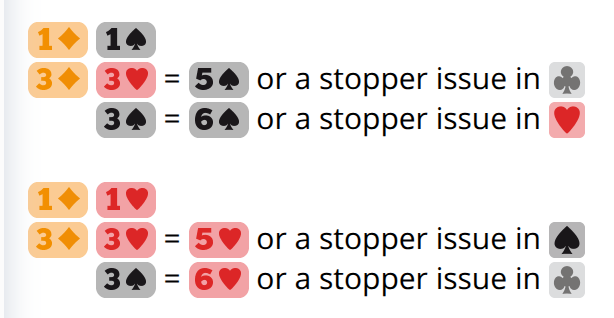
Natural 1♥
The major suit openings show 11–16 points and 5+ cards. I separate them into two chapters due to subtle differences in their continuations.
As 1♠ is natural, transfers only serve the heart raise.
| 1♥ - | |
|---|---|
| 1♠ | F, 4+♠ |
| 1NT | NAT NF, 0–3♠, 0–3♥ |
| 2♣! | (R), FG, 0–3♥, 0–3♠ |
| 2♦! | TRF, CONST 3+♥ |
| 2♥ | PRE, 3+♥ |
| 2♠ | PRE, 6+♠ |
| 2NT! | LIM+, 4+♥ |
| 3♣♦! | INV+, 5+#, 4+♥ |
| 3♥ | PRE, 4+♥ |
| 3♠! | SPL, 0–1♠, 4+♥ |
| 3NT! | COG, 33(43) |
| 4♣♦! | SPL, 0–1#, 4+♥ |
Natural 1♥ - 1♠
As the opening is limited to 11–16, the reverses are not forcing. The reverses show a maximum 5+ 5+ two suiter.
| 1♥ - 1♠ - | |
|---|---|
| 1NT | BAL 12–14 |
| 2♣ | 11–16, 4+♣ |
| 2♦ | 11–16, 4+♦ |
| 2♥ | 11–14, 6+♥ |
| 2♠ | 11–14, 4+♠ |
| 2NT! | 15–16, 6=♥, ≤ ♥AJ9 |
| 3♣♦ | 15–16, 5+# |
| 3♥ | 15–16, ((6+♥, AJT+) or 7+♥) |
| 3♠ | 15–16, 4+♠ |
| 3NT! | Gambling, 7+♥ AKQ, no outside A/K |
| 4♣♦! | SPL, 0–1#, 4+♠ |
Checkback Gladiator
Checkback Gladiator is also in effect after 1♥ - 1♠ - 1NT, similar to 1♦ - 1M - 1NT. There are 3 artificial relays in Checkback Gladiator:
- 2♣: several variants:
- to play 2x
- strongly shaped invitation
- balanced invitation or choice of games
- 2♦: game-forcing checkback, usually a choice of games
- 2NT: transfer to clubs
As a corollary, natural 2x are wide-range invitations and 3x become slam tries.
| 1♥ - 1♠ - 1NT - | |
|---|---|
| 2♣! | CB Gladiator, F1 |
| 2♣ - 2♦ | P/C |
| 2♣ - 2♥! | P/C, 4+♦ |
| 2♣ - 2♠! | MAX, 3=♠ |
| 2♦! | FG CB |
| 2♥ | INV, 2–3♥ |
| 2♠ | INV, 5+♠ |
| 2NT! | TRF, (PRE or FG), 6+♣ |
| 3♣ | S/T, 5+♣, 5+♠ |
| 3♦ | S/T, 5+♦, 5+♠ |
| 3♥ | S/T, 3+♥ |
| 3♠ | S/T, 6+♠ |
| 1♥ - 1♠ - 1NT - 2♣ - 2♦ - | |
|---|---|
| 2♥ | S/O, 2+♥ |
| 2♠ | S/O, 5+♠ |
| 2NT | BAL INV |
| 3♣ | INV, 6+♣ |
| 3♦ | INV, 6+♦ |
| 3♥ | MAX INV, 53(32) |
| 3♠ | MAX INV, 6+♠ |
Non-forcing 1NT
Opener is free to pass 1♥ - 1NT with a balanced minimum. The best major fit at 1♥ - 1NT - - is balanced 5-3. Opener can judge when to pass quite safely.
| 1♥ - 1NT - | |
|---|---|
| 2♣ | 11–16, 3+♣ |
| 2♦ | 11–16, 4+♦ |
| 2♥ | 11–14, 6+♥ |
| 2♠ | 15–16, 4+♠ |
| 2NT! | 15–16, 6=♥, ≤ ♥AJ9 |
| 3♣♦ | 15–16, 5+# |
| 3♥ | 15–16, ((6+♥, AJT+) or 7+♥) |
| 3♠ | 15–16, 4+♠, 6+♥ |
| 3NT! | Gambling, 7+♥ AKQ, no outside A/K |
Just like 1♠ - 1NT, the threshold of suit quality is based on Binky Points.
Impossible spades
Spades that responder rebids must be artificial because 1NT already denies spades. The impossible 2♠ is the invitational raise of opener’s last suit — clubs after 2♣, diamonds after 2♦, hearts after 2♥ — forcing for one round, so opener accepts game with a maximum or signs off in three of the suit. The direct three-level raise is the weaker, to-play version.
| 1♥ - 1NT - 2♣ - | |
|---|---|
| 2♦ | NF, 5+♦ |
| 2♥ | NF, usually 2–3♥ |
| 2♠! | INV, 4+♣ |
| 2NT | BAL INV |
| 3♣ | NF, 4+♣ |
| 3♦ | INV, 6+♦ |
| 3♥ | INV, 3=♥ |
| 1♥ - 1NT - 2♦ - | |
|---|---|
| 2♥ | NF, usually 2–3♥ |
| 2♠! | INV, 4+♦ |
| 2NT | BAL INV |
| 3♣ | INV, 6+♣ |
| 3♦ | NF, 4+♦ |
| 3♥ | INV, 3=♥ |
| 1♥ - 1NT - 2♥ - | |
|---|---|
| 2♠! | INV, 2+♥ |
| 2NT | BAL INV |
| 3♣♦ | INV, 6+# |
| 3♥ | NF, 3+♥ |
Precision 2NT
Like 1♠ - 1NT - 2NT, opener has pinned a narrow hand — a maximum with a weak six-card suit — so responder simply places the contract. Here the spade puppet has nothing to find: 1NT denied spades, so there is no second major, and the escape suits ♣♦ straddle hearts rather than sitting below the trump suit. Every call is therefore a natural sign-off — pass with a balanced minimum or retreat to a long minor or take the 6–3 heart fit at the level your strength buys.
| 1♥ - 1NT - 2NT - | |
|---|---|
| 3♣ | S/O, 6+♣ |
| 3♦ | S/O, 6+♦ |
| 3♥ | S/O, 3=♥ |
| 3NT | S/O, 0–2♥ |
| 4♥ | S/O, 3=♥ |
Game-forcing relay 2♣
| 1♥ - 2♣ - | |
|---|---|
| 2♦! | (R), 5=♥ |
| 2♥ | 11–14, 6+♥ |
| 2♠ | 15–16, 4+♠ |
| 2NT! | 15–16, 6=♥, ≤ ♥AJ9 |
| 3♣♦ | 15–16, 4+# |
| 3♥ | 15–16, ((6+♥, AJT+) or 7+♥) |
| 3♠ | 15–16, 5+♠, 6+♥ |
| 3NT! | Gambling, 7+♥ AKQ, no outside A/K |
Stenberg 2NT
The principle of fast arrival should not apply to an unlimited Jacoby 2NT. The weaker opener is, the more likely responder has something to say. Therefore, I import responses from Stenberg, aka Swedish Jacoby 2NT.
| 1♥ - 2NT - | |
|---|---|
| 3♣! | MIN |
| 3♦! | MAX, no SPL |
| 3♥! | MAX FRAG, 0–1♣ |
| 3♠! | MAX FRAG, 0–1♦ |
| 3NT! | MAX FRAG, 0–1♠ |
| 4♣ | MAX, 5+♣ |
| 4♦ | MAX, 5+♦ |
| 4♥! | MAX, 6+♥, 4+♠ |
| 1♥ - 2NT - 3♣ - | |
|---|---|
| 3♦! | (R), FG |
| 3♥ | S/O |
| 3NT | BAL choice of games |
| 1♥ - 2NT - 3♣ - 3♦ - | |
|---|---|
| 3♥! | FRAG, 0–1♣ |
| 3♠! | FRAG, 0–1♦ |
| 3NT! | FRAG, 0–1♠ |
| 4♣ | 5+♣ |
| 4♦ | 5+♦ |
| 4♥ | Nearly BAL |
Passed-hand responses
Late-seat 1♥ reduces to a fairly natural system.
| P - 1♥ - | |
|---|---|
| 2♣! | LIM, 3+♥ |
| 2♦♠ | INV, 5+# |
| 2♥ | CONST, 3+♥ |
| 3♥ | CONST, 4+♥ |
(Reverse) Drury
Reverse Drury is de facto standard. The original Drury becomes the lesser panda.
| P - 1♥ - 2♣ - | |
|---|---|
| 2♦! | (R) |
| 2♥ | S/O, a light opening |
| 2♠ | 4+♠ |
| 2NT+ | NAT FG |
Competing at the 1-level
Notrump becomes cuebid after a double. We still need fit-showing jumps, so Truscott 2NT fits well.
| 1♥ (X) | |
|---|---|
| XX | NF BAL G/T, 10+ |
| 1♠ | Usually 5+♠ |
| 1NT! | TRF, 5+♣ |
| 2♣! | TRF, 5+♦ |
| 2♦! | TRF, 8+, 3+♥ |
| 2♥ | PRE, 0–7, 3+♥ |
| 2♠! | LIM+, 3=♥, 6+♠♦♣ |
| 2NT! | LIM+, 4+♥ |
| 3♣♦! | CONST+, 5+#, 4+♥ |
| 3♥ | COMP, 7–9, 4+♥ |
Bo-Yin Yang found that 1♥ (1♠) is highly similar to 1♥ (X) and introduced the following bidding structure to BTU in 1999.
| 1♥ (1♠) | |
|---|---|
| X | T/O, maybe BAL |
| 1NT! | TRF, 5+♣ |
| 2♣! | TRF, 5+♦ |
| 2♦! | TRF, 9–11, 3+♥ |
| 2♥ | PRE, 4–8, 3+♥ |
| 2♠! | FG, 3=♥ |
| 2NT! | LIM+, 4+♥ |
| 3♣♦! | CONST+, 5+#, 4+♥ |
| 3♥ | COMP, 7–9, 4+♥ |
| 3♠! | S/T, 3+♥ w/o ♠ CTRL |
| 3NT! | COG, 3+♥ w/ ♠ A/K |
| 4♣! | FRAG, 3+♥, 0–1♠ |
| 4♦! | STR PRE, 4+♥ |
| 4♥ | PRE, UNBAL 4+♥ |
Competing at the 2-level
Over (1NT)
I suggest bidding mostly naturally over 1♥ (1NT), including 2♣.
| 1♥ (1NT) | |
|---|---|
| X | PEN, INV+ |
| 2NT! | LIM 4+♥ or UNBAL FG |
Over a minor suit
Transfers à la Rubens applies over 1♥ (2♣♦). Note that 2NT is natural because we still have 2♥.
| 1♥ (2♣♦) | |
|---|---|
| X | T/O |
| 2♦♠ | NF, 5+# |
| 2♥ | NF, 3+♥ |
| 2NT | NAT, 9–11 |
| 3♦! | LIM+, 3+♥ |
| 3♥ | CONST, 4+♥ |
| 3♠ | FG, 6+♠ |
| 1♥ (2♣) | |
|---|---|
| 3♣! | INV+, 6+♦ |
| 1♥ (2♦) | |
|---|---|
| 3♣ | INV, 6+♣ |
Over a major suit
Rubinsohl applies when opponents bid spades, the only suit higher than our hearts. Responses 3♠ and above are the same as over 1♥ (1♠).
| 1♥ (2♠) | |
|---|---|
| X! | OPT, INV+ |
| 2NT! | TRF, 5+♣ |
| 1♥ (2♥♠) | |
|---|---|
| 3♣! | TRF, 5+♦ |
| 3♦! | INV+, 3+♥ |
| 3♥ | COMP, 3+♥ |
| 3♠! | S/T, 3+♥ w/o ♠ CTRL |
| 3NT! | COG, 3+♥ w/ ♠ A/K |
| 4♣! | FRAG, 3+♥, 0–1♠ |
| 4♦! | STR PRE, 4+♥ |
| 4♥ | PRE, UNBAL 4+♥ |
Doubling the cuebid is penalty oriented and lead directing. It promises strength, denies good distributional raise (balanced 3=♥ at most), and encourages leading from a side suit.
| 1♥ (2♥) | |
|---|---|
| X | PEN, INV+ |
If the only known suit from (2♥) is spades, plain Rubens suffices. X and 2NT switch roles.
| 1♥ (2♥) | ♠ (+ unknown suit) |
|---|---|
| 2♠! | TRF, 5+♣ |
| 2NT! | NF T/O |
If (2♥) shows two known suits, BTU vs Unusual applies.
Natural 1♠
The major suit openings show 11–16 points and 5+ cards. I separate them into two chapters due to subtle differences in their continuations.
To allow a choice between 4♥ and 4♠, 1♠ - 3♥ shows an invitation with 36(xx) rather than 45(xx).
| 1♠ - | |
|---|---|
| 1NT | NAT NF, 0–3♠ |
| 2♣! | (R), FG, 0–3♠, 0–4♥ |
| 2♦! | TRF: (INV+, 5+♥) or (CONST, 6+♥) |
| 2♥! | TRF, CONST 3+♠ |
| 2♠ | PRE, 3+♠ |
| 2NT! | LIM+, 4+♠ |
| 3♣♦! | INV+, 5+#, 4+♠ |
| 3♥! | INV, 6+♥, 3=♠ |
| 3♠ | PRE, 4+♠ |
| 3NT! | COG, 33(43) |
| 4x! | SPL, 0–1#, 4+♠ |
Semi-forcing 1NT
| 1♠ - 1NT - | |
|---|---|
| 2♣ | 11–16, 2+♣ |
| 2♦ | 11–16, 4+♦ |
| 2♥ | 11–16, 4+♥ |
| 2♠ | 11–14, 6+♠ |
| 2NT! | 15–16, 6=♠, ≤ ♠AJ9 |
| 3♣♦♥ | 15–16, 5+# |
| 3♠ | 15–16, ((6+♠, AJT+) or 7+♠) |
| 3NT! | Gambling, 7+♠ AKQ, no outside A/K |
The threshold of suit quality is based on Binky Points:
Holding     NT   Suit
 KQJxxx   0.20   0.14
 AT9xxx   0.13   0.14
 KQJ9xx   0.21   0.19
 AJxxxx   0.32   0.23
 KQJTxx   0.29   0.26
 KQJT9x   0.29   0.29
 AJ9xxx   0.44   0.29
 AJTxxx   0.57   0.40
 AJT9xx   0.63   0.45
 AQxxxx   0.76   0.52
 AQ9xxx   0.86   0.57
 AQTxxx   0.99   0.65
—
holdings.new.txt, Binky Points computed by Thomas Andrews in 2008
Precision 2NT
The invitational 2NT from Precision shows 6 cards in the major. Opener is a narrow maximum, so responder places the contract. The only artificial bid is 3♣, asking whether opener holds three hearts so that a 5–3 heart game can replace 4♠ or 3NT. Everything else is natural — a weak club one-suiter has to pass.
| 1♠ - 1NT - 2NT - | |
|---|---|
| 3♣! | Ask for 3+♥ |
| 3♦ | S/O, 6+♦ |
| 3♥ | S/O, 6+♥ |
| 3♠ | S/O, 3=♠ |
| 3NT | S/O |
| 4♠ | S/O, 3=♠ |
| 1♠ - 1NT - 2NT - 3♣ - | |
|---|---|
| 3♦! | 0–2♥ |
| 3♥ | 3+♥ |
Game-forcing relay 2♣
| 1♠ - 2♣ - | |
|---|---|
| 2♦! | (R), 5=♠ |
| 2♥ | 11–16, 4+♥ |
| 2♠ | 11–14, 6+♠ |
| 2NT! | 15–16, 6=♠, ≤ ♠AJ9 |
| 3♣♦ | 15–16, 4+# |
| 3♥ | 15–16, 5+♥ |
| 3♠ | 15–16, ((6+♠, AJT+) or 7+♠) |
| 3NT! | Gambling, 7+♠ AKQ, no outside A/K |
Transfer 2♦
This 2♦ transfer from Ambra makes it easier for opener to judge the right contract.
- Invitational+ (10+) 5+♥
- Constructive (8–10) 6+♥
In standard bidding methods, 1♠ - 1NT may conceal a heart fit. Finding the right contract for a 3-5 heart fit is challenging. Bart-style gadgets try to fix it after a whole round of bidding.
| 1♠ - 2♦ - | |
|---|---|
| 2♥ | NF, 2–4♥ |
| 2♠ | NF, 0–2♥ |
| 2NT! | FG, 2+♥ |
| 3♣♦ | FG, 4+#, 0–1♥ |
| 3♥ | INV, 3–4♥ |
| 3♠ | FG, 6+♠, 0–1♥ |
| 3NT! | MIN SPL, 0–1♦, 4=♥ |
| 4♣! | MIN SPL, 0–1♣, 4=♥ |
| 4♦! | MIN SPL, 0–1♦, 5+♥ |
| 4♥! | MIN SPL, 0–1♣, 5+♥ |
Stenberg 2NT
The principle of fast arrival should not apply to an unlimited Jacoby 2NT. The weaker opener is, the more likely responder has something to say. Therefore, I import responses from Stenberg AKA Swedish Jacoby 2NT.
| 1♠ - 2NT - | |
|---|---|
| 3♣! | MIN |
| 3♦! | MAX, no SPL |
| 3♥! | MAX FRAG, 0–1♣ |
| 3♠! | MAX FRAG, 0–1♦ |
| 3NT! | MAX FRAG, 0–1♥ |
| 4♣ | MAX, 5+♣ |
| 4♦ | MAX, 5+♦ |
| 4♥ | MAX, 5+♥ |
| 1♠ - 2NT - 3♣ - | |
|---|---|
| 3♦! | (R), FG |
| 3♠ | S/O |
| 3NT | BAL choice of games |
| 1♠ - 2NT - 3♣ - 3♦ - | |
|---|---|
| 3♥! | FRAG, 0–1♣ |
| 3♠! | FRAG, 0–1♦ |
| 3NT! | FRAG, 0–1♥ |
| 4♣ | 5+♣ |
| 4♦ | 5+♦ |
| 4♥ | 5+♥ |
| 4♠ | Nearly BAL |
Passed-hand responses
Late-seat 1♠ reduces to a fairly natural system.
| P - 1♠ - | |
|---|---|
| 2♣! | LIM, 3+♠ |
| 2♦♥ | INV, 5+# |
| 2♠ | CONST, 3+♠ |
| 3♠ | CONST, 4+♠ |
(Reverse) Drury
Reverse Drury is de facto standard. The original Drury becomes the lesser panda.
The subsequent 2♥ is never light in this bidding system. A light hand with both majors would have opened Ekren 2♣ instead.
| P - 1♠ - 2♣ - | |
|---|---|
| 2♦! | (R) |
| 2♥ | 4+♥ |
| 2♠ | S/O, a light opening |
| 2NT+ | NAT FG |
Competitive bidding
Notrump becomes a cuebid after a double. We still need fit-showing jumps, so Truscott 2NT fits well.
| 1♠ (X) | |
|---|---|
| XX | NF BAL G/T, 10+ |
| 1♠ | Usually 5+♠ |
| 1NT! | TRF, 5+♣ |
| 2♣! | TRF, 5+♦ |
| 2♦! | TRF, 5+♥ |
| 2♥! | TRF, 8+, 3+♠ |
| 2♠ | PRE, 0–7, 3+♠ |
| 2NT! | LIM+, 4+♠ |
| 3♣♦! | CONST+, 5+#, 4+♠ |
| 3♥! | INV, 6+♥, 3=♠ |
| 3♠ | COMP, 7–9, 4+♠ |
Natural defense suffices over 1♠ (1NT).
| 1♠ (1NT) | |
|---|---|
| X | PEN, INV+ |
| 2NT! | LIM 4+♠ or UNBAL FG |
Transfers à la Rubens apply over 1♠ (2♣♦♥). Note that 2NT is natural because we still have 2♠.
| 1♠ (2x) | |
|---|---|
| X | T/O |
| 2y | NF, 5+# |
| 2♠ | NF, 3+♠ |
| 2NT | NAT, 9–11 |
| 3♥! | LIM+, 3+♠ |
| 3♠ | CONST, 4+♠ |
| 1♠ (2♣) | |
|---|---|
| 3♣! | INV+, 6+♦ |
| 3♦! | INV+, 6+♥ |
| 1♠ (2♦) | |
|---|---|
| 3♣ | INV, 6+♣ |
| 3♦! | INV+, 6+♥ |
| 1♠ (2♥) | |
|---|---|
| 3♣♦ | INV, 6+# |
Doubling the cuebid is penalty oriented and lead directing.
| 1♠ (2♠) | |
|---|---|
| X | PEN, INV+ |
If the only known suit from (2♠) is hearts, plain Rubens suffices. X and 2NT switch roles.
| 1♠ (2♠) | ♥ (+ unknown suit) |
|---|---|
| 2NT! | NF T/O |
| 3♣♦ | INV, 6+# |
| 3♥! | LIM+, 3+♠ |
| 3♠ | COMP, 3+♠ |
If (2♠) shows two known suits, BTU vs Unusual applies.
Strong 1NT
This bidding system has a strong notrump opening. In contrast to Polish Club 2020, this opening allows a 5-card major or a 6-card minor. All the possible distributions are:
- 2–4♠, 2–4♥, 2–6♦, 2–6♣
- 5M(332)
Inclusive opening of 1NT solves rebidding problems:
- Failure to reverse (especially a red suit) in competition
- Awful rebidding to 1♥ - 1♠
- Tricky rebidding to 1♥♠ - 1NT
Narrow (11–16) major suit openings welcome Precision-like continuations. Fast and precise bidding follows. Now we open 1NT for balanced 17-counts and 1♣ for unbalanced ones.
| 1NT - | |
|---|---|
| 2♣! | STAY, maybe crawling |
| 2♦! | TRF, 5+♥ |
| 2♥! | TRF, 5+♠ |
| 2♠! | 6+♣ or QUANT INV |
| 2NT! | 6+♦ or (5+♦, 4+♣) |
| 3♣! | PUP STAY |
| 3♦! | INV+, 5+♠, 5+♥ |
| 3♥! | SPL, 0–1♥, 0–3♠, 4–6♦, 4–6♣ |
| 3♠! | SPL, 0–1♠, 0–3♥, 4–6♦, 4–6♣ |
| 3NT | S/O |
| 4♣! | TRF, 6+♥, South African Texas |
| 4♦! | TRF, 6+♠, South African Texas |
| 4♥♠ | S/O |
| 4NT | QUANT INV to 6NT, NF |
| 5NT | QUANT INV to 7NT, F |
Picking the better Stayman
Both Staymans come into range when responder has game-forcing values.
- 5+ 4+ majors: Stayman 2♣ wins via subsequent Smolen transfers.
- 4− 3− majors: Only Puppet Stayman 3♣ finds 5-3 fits.
- Balanced 4-4 majors: The lower 2♣ allows playing 3NT if opener is (4333).
- Unbalanced 4-4 majors: Anything goes.
Crawling Stayman
Crawling Stayman, a superset of Garbage Stayman, is an agreement to let 2♣ include weak hands.
- Garbage Stayman: 3+♠, 3+♥, 4+♦
- Crawling Stayman: 4+♠, 4+♥, 0–4♦, besides Garbage Stayman
The ulterior motive of Garbage Stayman is to pass any opener’s rebid, including 2♦. Crawling Stayman expands the plan. Responder can now take out with weak 4+♠ and 4+♥, even short in diamonds. Responder crawls to 2♥ P/C over 2♦ when lacking diamonds.
Discussion on bidding 4=♠ and 5+♥
Crawling Stayman has a side effect. The standard meaning of 2♣ - 2♦ - 2♥ needs a new home. Luckily, there is a spare step after the heart transfer because we bid 3♦ for invitational+ 5+ 5+ majors.
- Invitational: Transfer to hearts and then bid 2NT!
- Game-forcing: Bid Stayman 2♣. Smolen transfers follow.
Discussion on bidding 5+ 5+ majors
- Invitational: Bid 3♦.
- Choice of games: Bid 3♦ most of the time. Transfer to spades and then bid 4♥ if you prefer 4♠ > 4♥ > 3NT.
- Slam try: Transfer to spades and then bid 3♥.
Opener picks the major, declining game at the three level or accepting at the four level. With a maximum and a doubleton in each major (e.g. 22(54)), opener picks 3NT instead. With a maximum and slam interest, opener control-bids 4♣ or 4♦ rather than jumping straight to game:
| 1NT - 3♦ - | |
|---|---|
| 3♥ | MIN, prefers ♥ |
| 3♠ | MIN, prefers ♠ |
| 3NT | MAX, dislikes both majors |
| 4♣! | MAX, S/T in ♥, CTRL |
| 4♦! | MAX, S/T in ♠, CTRL |
| 4♥ | MAX, prefers ♥, S/O |
| 4♠ | MAX, prefers ♠, S/O |
A choice-of-games responder raises opener’s three-level pick to game.
Minor suit transfers
| 1NT - 2♠ - | |
|---|---|
| 2NT | MIN |
| 3♣! | MAX, 1–3♣ |
| 3♣ - 3♦! | FG PUP STAY |
| 3♣ - 3♥♠! | SPL, 0–1# |
| 3♦♥♠! | MAX, 4–6♣, good stopper |
| 1NT - 2NT - | |
|---|---|
| 3♣! | 1–2♦ |
| 3♦ | 3–4♦ |
| 3♥♠! | 5–6♦, good stopper |
| 3NT! | 5–6♦, good ♣ stopper |
Puppet Stayman at 3♣
| 1NT - 3♣ - | |
|---|---|
| 3♦! | 2–4♠, 2–4♥ |
| 3♦ - 3♥! | Smolen TRF, 4=♠ |
| 3♦ - 3♠! | Smolen TRF, 4=♥ |
| 3♦ - 3NT | S/O |
| 3♦ - 4♣! | S/T, 44(xx) |
| 3♦ - 4♦! | COG, 44(xx) |
| 3♥♠ | 5=# |
Stayman 2♣
- Weak: garbage (3+♠, 3+♥, 4+♦) or crawling (4+♠, 4+♥, 0–4♦)
- Invitational: 4=♥ or (4=♠, 0–4♥)
- Game-forcing: (4=♠ or 4=♥), but not (43)(xx)
| 1NT - 2♣ - | |
|---|---|
| 2♦! | 2–3♠, 2–3♥ |
| 2♥ | 4–5♥, 2–4♠ |
| 2♠ | 4–5♠, 2–3♥ |
1NT - 2♣ - 2♦
Second responses above 3NT remain the same, assuming misfit.
| 1NT - 2♣ - 2♦ - | |
|---|---|
| P | S/O, 4+♦ |
| 2♥ | P/C, 4+♥, 4+♠, 0–4♦ |
| 2♠ | INV, 5+♠, 4+♥ |
| 2NT | NAT INV |
| 3♣ | FG, 5+♣ |
| 3♦ | FG, 5+♦ |
| 3♥! | FG, Smolen TRF, 54(xx) |
| 3♠! | FG, Smolen TRF, 45(xx) |
| 4♣! | TRF, 6+♥, 4=♠, South African Texas |
| 4♦! | TRF, 6+♠, 4=♥, South African Texas |
| 4♥♠ | S/O |
| 4NT | QUANT INV to 6NT |
| 5NT | QUANT INV to 7NT |
1NT - 2♣ - 2♥
- The quantitative scheme remains, assuming misfit.
- 3♠ is a generic fit slam try, so 4NT is quantitative instead of RKCB.
| 1NT - 2♣ - 2♥ - | |
|---|---|
| 2♠ | INV, 5+♠, 4+♥ |
| 2NT | INV, 0–3♥, 4=♠ |
| 3♣ | FG, 5+♣, 0–3♥, 4=♠ |
| 3♦ | FG, 5+♦, 0–3♥, 4=♠ |
| 3♥ | INV, 4+♥, 0–4♠ |
| 3♠! | S/T, 4+♥ |
| 4♣♦! | S/T SPL, 0–1#, 4+♥ |
| 4NT | QUANT INV to 6NT |
| 5NT | QUANT INV to 7NT |
1NT - 2♣ - 2♠
- Only the standard quantitative scheme remains. Now 4♠ is a signoff.
- 3♥ is a generic fit slam try, so 4NT is quantitative instead of RKCB.
| 1NT - 2♣ - 2♠ - | |
|---|---|
| 2NT | INV, 0–3♠, 4=♥ |
| 3♣ | FG, 5+♣, 0–3♠, 4=♥ |
| 3♦ | FG, 5+♦, 0–3♠, 4=♥ |
| 3♥! | S/T, 4+♠ |
| 3♠ | INV, 4+♠ |
| 4♣♦♥! | S/T SPL, 0–1#, 4+♠ |
| 4♠ | S/O, 4+♠ |
| 4NT | QUANT INV to 6NT |
| 5NT | QUANT INV to 7NT |
Jacoby transfers 2♦♥
Opener super-accepts with maximum 4-card support. To help game try, opener tries to show (4333) or a good side suit.
1NT - 2♦
Responder rebids forcing 2♠ for a 5=♥ invitation. This forcing bid allows invitation by distribution, e.g. also 5+♦♣.
Responder rebids 2NT for 4=♠ invitation. Crawling Stayman moves these hands here from Stayman 2♣.
| 1NT - 2♦ - | |
|---|---|
| 2♥ | (R) |
| 2♠! | MAX, 4=♠, 4=♥ |
| 2NT | MAX, 3433 |
| 3♣! | MAX, good 4+♣, 4=♥ |
| 3♦! | MAX, good 4+♦, 4=♥ |
| 3♥ | MAX, 4=♥, none of the above |
| 1NT - 2♦ - 2♥ - | |
|---|---|
| 2♠! | F INV, 0–3♠, 5=♥ |
| 2NT! | INV, 4=♠ |
| 3♣! | FG, 4+♣ |
| 3♦! | FG, 4+♦ |
| 3♥ | INV, 6+♥ |
| 3NT | BAL P/C |
| 3♠!, 4♣♦! | SPL, 0–1#, 6+♥ |
| 4♥ | S/O, 6+♥ |
| 4NT | QUANT INV to 6NT |
| 5NT | QUANT INV to 7NT |
| 1NT - 2♦ - 2♥ - 2♠ - | |
|---|---|
| 2NT | MIN, 15 HCP, 2=♥ |
| 3♣! | P/C, 16 HCP, 2=♥ |
| 3♦! | P/C, 16 HCP, 2=♥, 5+♣ |
| 3♥ | MIN, 3=♥ |
| 3NT | S/O, 17 HCP, 2=♥ |
1NT - 2♥
| 1NT - 2♥ - | |
|---|---|
| 2♠ | (R) |
| 2NT! | MAX, 4333 |
| 3♣! | MAX, good 4+♣, 4=♠ |
| 3♦! | MAX, good 4+♦, 4=♠ |
| 3♥! | MAX, 4=♥, 4=♠ |
| 3♠ | MAX, 4=♠, none of the above |
| 1NT - 2♥ - 2♠ - | |
|---|---|
| 2NT | INV, 5=♠ |
| 3♣! | FG, 4+♣ |
| 3♦! | FG, 4+♦ |
| 3♥! | S/T, 5+♥ |
| 3♠ | INV, 6+♠ |
| 3NT | BAL P/C |
| 4♣♦! | SPL, 0–1#, 6+♠ |
| 4♥ | COG, 5+♥, prefer 4♠ > 4♥ |
| 4♠ | S/O, 6+♠ |
| 4NT | QUANT INV to 6NT |
| 5NT | QUANT INV to 7NT |
Competitive bidding
1NT (X)
I suggest Terrorist’s runout regardless of what (X) means. This runout also applies to a conventional double, yet responder can also pass balanced hands more often.
| 1NT (X) | |
|---|---|
| XX | PEN |
| 2♣! | P/C: 5+♣ or (4+♦, 4+♠♥) |
| 2♦! | P/C: 5+♦ or (4+♠, 4+♥) |
| 2M | NF, 5+# |
| 2NT! | CUE, good unbalanced hand |
| 3x | PRE, 6+# |
Opener often runs with clubs because it is hard for responder to do so.
| 1NT (X) - - | |
|---|---|
| XX | 5+ suit |
| 2♣! | 4+♣, 4+ another suit |
1NT (2♣)
Systems on is a decent approach over 1NT (2♣︎). The overcall is somewhat ignored, and X replaces the stolen bid of 2♣. Since continuations over 1NT are major-suit oriented, it matters whether (2♣) shows a major suit.
(2♣) shows both majors
This kind of 2♣︎ requires extra care. I recommend BTU vs Unusual.
| 1NT (2♣) | Both majors |
|---|---|
| X | PEN for either major |
| 2♦ | NF, 5+♦ |
| 2♥! | FG, 5+♦ |
| 2♠! | INV+, 5+♣ |
| 2NT! | LEB: PRE 6+♣ or FG (xx)45 |
| 3♣♦ | INV, 6+# |
| 3♥♠! | Ask for stopper in this suit |
(2♣) specifies one major
This position is analogous to (1M) 1NT. X replaces the Gladiator 2♣.
(2♣) specifies no major
Ignore the (2♣) overcall. X replaces the Stayman 2♣ as usual.
1NT (2♦♥♠)
Rubinsohl covers these auctions. As with Rubens advances, transfer structure saves bidding space. Showing the suit quickly also improves competitive accuracy.
| 1NT (2♦) | |
|---|---|
| X | OPT |
| 2M | NAT NF |
| 2NT! | TRF to 3♣ |
| 3♣! | STAY |
| 3♦! | INV+ TRF to 3♥ |
| 3♥! | INV+ TRF to 3♠ |
| 3♠! | FG TRF to 3NT or 4♣ |
| 1NT (2♥) | |
|---|---|
| X | OPT |
| 2♠ | NAT NF |
| 2NT! | TRF to 3♣ |
| 3♣! | TRF to 3♦ |
| 3♦! | STAY |
| 3♥! | INV+ TRF to 3♠ |
| 3♠! | FG TRF to 3NT or 4♣ |
Against (2♠), swap 3♥ and 3♠ as in Larry Cohen to avoid declaring hearts.
| 1NT (2♠) | |
|---|---|
| X | OPT |
| 2NT! | TRF to 3♣ |
| 3♣! | TRF to 3♦ |
| 3♦! | TRF to 3♥ |
| 3♥! | FG TRF to 3NT or 4♣ |
| 3♠! | FG STAY |
1NT (2NT)
BTU vs Unusual suffices.
| 1NT (2NT) | 5+♦, 5+♣ |
|---|---|
| X | PEN |
| 3♣! | INV+, 5+♠ |
| 3♦! | INV+, 5+♥ |
| 3♥♠ | NF, 5+# |
| 3NT | S/O |
| 4♣! | COG, 4+♠, 5+♥ |
Ekren 2♣
Ekren is an artificial preempt showing 4+ cards in each major. It is originally at 2♦. Polish Club 2020: Expert moves it to 2♣ to replace Precision 2♣ and leaves space for Multi.
| 2♣ - | |
|---|---|
| 2♦! | (R): INV+ or equal preference |
| 2NT | NAT INV |
| 3♣! | FG, 3+♥ |
| 3♦ | NAT NF, 6+♦ |
| 3♥♠ | COMP, 4+# |
| 4♣! | STR COG |
| 4♦! | PRE COG |
The 2♦ relay asks for distribution or parks any invitation. The step for 6+♠ is moved down to 2NT, so responder can still invite 4♥ with 3♥.
| 2♣ - 2♦ - | |
|---|---|
| 2♥ | 4=♠, 4–5♥ |
| 2♠ | 5=♠, 4–5♥ |
| 2NT! | 6+♠ |
| 3♣! | SPL, 0–1♣, 5=♠, 5+♥ |
| 3♦! | SPL, 0–1♦, 5=♠, 5+♥ |
| 3♥ | 6+♥ |
The 3♣ relay is a fast ask for hearts because 2♦ already quickly asks for spades. Smolen-like rebids let the strong responder declare.
| 2♣ - 3♣ - | |
|---|---|
| 3♦! | 4=♥, 4=♠ |
| 3♥! | 4=♥, 5+♠ |
| 3♠! | 5+♥ |
There are two kinds of choice of games:
- 4♣ by strength
- 4♦ by distribution
Such distinction helps judging how to react to interference. Besides, 4♣ lets the strong hand declare. On the other hand, 4♦ closes the auction ASAP.
| 2♦ - 4♣ - | |
|---|---|
| 4♦! | TRF, ♥ ≥ ♠ |
| 4♥! | TRF, ♠ > ♥ |
Competitive bidding
It is more useful and possible to play 2♣x than 2♣xx. The ask hence relocates to XX while pass is to play.
| 2♣ (X) | |
|---|---|
| XX | (R): INV+ or equal preference |
| P | NAT, 5+♣ |
| 2♦ | NAT, 5+♦ |
Multi 2♦
Multi 2♦ shows a 6-card weak two of either major.
| 2♦ - | |
|---|---|
| 2♥♠! | P/C |
| 2NT! | (R) INV+ |
| 3♣♦ | NAT F |
| 3♥♠! | P/C |
| 3NT | S/O |
| 4♣! | STR COG |
| 4♦! | PRE COG |
| 4♥♠ | S/O |
There are two common approaches to rebid after the 2NT inquiry:
- Bisect strength and keep all contracts right-sided.
- Trisect strength but allow 3♥♠ to be wrong-sided.
I prefer trisection because it allows accurate description of a wild 2♦ opening.
| 2♦ - 2NT - | |
|---|---|
| 3♣! | INV+, 6+♥ |
| 3♦! | INV+, 6+♠ |
| 3♥ | MIN, 6+♥ |
| 3♠ | MIN, 6+♠ |
There are two kinds of choice of games:
- 4♣ by strength
- 4♦ by distribution
Such distinction helps judging how to react to interference. Besides, 4♣ lets the strong hand declare. On the other hand, 4♦ closes the auction ASAP.
| 2♦ - 4♣ - | |
|---|---|
| 4♦! | TRF, 6+♥ |
| 4♥! | TRF, 6+♠ |
Competitive bidding
Passing the double clearly shows a willingness to play in 2♦x. The question is how to use XX. I recommend using XX to complement 2♥♠ and make efficient use of bidding space. This premise narrows the options down to two promising treatments:
- XX asks for opener’s long major, while 2♥♠ are natural.
- XX asks for opener’s short major, while 2♥♠ retain their P/C meanings.
I prefer the latter, as the former leaves the meaning of 3♥♠ unclear.
| 2♦ (X) | |
|---|---|
| XX! | Ask for the short major |
| 2♥♠! | P/C |
Muiderberg 2M
Muiderberg shows exactly 5 cards in the bid major and a side minor suit. Multi 2♦ already takes care of 6+ cards. I recommend response structure combining Meckstroth and transfer advances.
| 2M - | |
|---|---|
| 2♠! | NAT NF |
| 2NT! | INV+, ask for the minor suit |
| 3♣! | P/C |
| 2♥ - | |
|---|---|
| 3♦! | INV+, 3+♥ |
| 2♠ - | |
|---|---|
| 3♦! | TRF: (FG, 5+♥) or (INV, 6+♥) |
| 3♥! | INV+, 3+♠ |
| 2M - 2NT - | |
|---|---|
| 3♣ | MIN, 4+♣ |
| 3♦ | MIN, 4+♦ |
| 3♥! | MAX, 4=♣ |
| 3♠! | MAX, 4=♦ |
| 3NT! | MAX, 5+♦ |
| 4♣ | MAX, 5+♣ |
Unusual 2NT opening
The unusual 2NT opening is a preempt with 5+♦ and 5+♣. Bidding all strong hands with 1♣ frees up 2NT as a preempt.
I advise not opening 2NT for (30)55 in the first two seats.
| 2NT - | |
|---|---|
| 3♣♦ | S/O |
| 3♥! | (R) FG |
| 3♠! | PUP: S/T or UNBAL INV |
| 3NT, 4x | S/O |
| 4NT! | Equal preference between 5♣♦ |
| 2NT - 3♥ - | |
|---|---|
| 3♠! | SPL, 0–1♠ |
| 3NT! | SPL, 0–1♥ |
| 4♣ | MAX 1156 |
| 4♦ | MAX 1165 |
| 2NT - 3♥ - 4♣♦ - | |
|---|---|
| 4♥! | RKCB in ♣ |
| 4♠! | RKCB in ♦ |
| 4NT | S/O |
| 2NT - 3♠ - 3NT - | |
|---|---|
| 4♣ | INV, 3+♣ |
| 4♦ | INV, 3+♦ |
| 5♣! | S/T, 3+♣ |
| 5♦! | S/T, 3+♦ |
BTU Namyats
BTU uses a 4x scheme that conveys ~0.58 more bits than traditional or Meckwell Namyats.
- 4♣: solid major suit without any outside A/K
- 4♦: semi-solid major suit with 0–1 outside A/K
- 4M: non-solid (1.5+ NLTC) major suit
| 4x - | |
|---|---|
| 4NT! | RKCB |
| 5m! | CTRL ASK |
| 4x - 5m - | |
|---|---|
| +1 | No CTRL |
| +2 | K or singleton |
| +3 | A or void |
| 4♣♦ - | |
|---|---|
| 4♦! | (R) S/T |
| 4M!, 5M!, 6M! | P/C |
| 4♣ - 4♦ - | |
|---|---|
| 4M | NAT MIN |
| 4NT! | MAX, CTRL in every side suit |
| 5♣! | MAX, no CTRL in ♣ |
| 5♦! | MAX, no CTRL in ♦ |
| 5M! | MAX, no CTRL in OM |
| 4♥ - | |
|---|---|
| 4♠ | S/O |
Cuebids
Adverse calls may take away bidding space, but they can also grant us cuebids. The natural meaning of a strain can be rendered infeasible in competition. (Cooperative) penalty scores better than playing in an adverse strain (and at a higher level). Allocating useful artificial meaning to cuebids follows the useful space principle and is the key to fight back intervention.
Finding cuebids
Cuebids are obvious opposing a natural bid. Locating cuebids over an artificial call requires some discussion.
It is tempting to ignore opposing doubles. However, I suggest using notrump as cuebids over doubles. XX shows interest in penalty with strength and a probable misfit. Since XX overlaps with the natural meaning of notrump, reusing notrump as cuebids is more efficient. This idea gave birth to Truscott 2NT and Rubens over 1♦♥♠ (X).
Aritificial calls are trickier. Usually, the referred strains are used as cuebids. X, NT, and the nominal strain need specific agreements.
Transfer à la Rubens
Unassuming cuebids show support stronger than direct raises. Jeff Rubens found out that good raises need little further clarification. On the other hand, forcing new suits suffer from their wide range. Rubens advances rearrange [cuebid .. raise) into transfers.
This philosophy can be generalized to other competitive situations, e.g. when we open:
- Transfer Walsh, X as the stolen cuebid
- Rubinsohl, NT as (another) cuebid
BTU vs Unusual
When opponents have bid two suits, optimists take the opportunity to gain two cuebids! When opponents have shown two anchor suits, it’s time for Unusual vs Unusual.
The third cuebid
This is one key difference between BTU vs Unusual and the literature. The BTU variation uses the lowest three bids from the following list:
- The cuebids, the bids that name an opponent suit
- 2NT or 4NT
Let me provide some examples for clarity.
| Auction | BTU v U bids |
|---|---|
| 1♦ (2♦ = ♠ + ♥) | 2♥, 2♠, 2NT |
| 1♠ (2NT = ♦ + ♣) | 3♣, 3♦, 4♣ |
| 1♠ (3♣ = ♥ + ♦) | 3♦, 3♥, 4♣ |
| 2♥ (4♦ = ♠ + ♦) | 4♠, 4NT, 5♦ |
| (1♦) - (1♠) | 2♦, 2♠, 2NT |
| (1♦) 1♥ (X = ♠) | 1♠, 2♦, 2♠ |
To keep discussion simple, I abbreviate these BTU v U bids as Q1, Q2, Q3. If a cuebid is 4NT or higher, I recommend treating it as the start of another slam-try convention (e.g. RKCB or Turbo), subject to partnership agreement.
We have one anchor suit
Rubens advances tell us that a fit requires less space. Therefore, Q1 maps to the new suit, and Q2 is the forcing raise.
- Q1 = 5+ new suit
- Q2 = forcing raise
- Q3 = new suit + mediocre forcing raise
We have 0 or 2 anchor suits
Unlike the intuitive lower-lower approach, BTU v U maps Q1 to the higher-ranking suit.
- Q1 = 5+ higher-ranking suit
- Q2 = 5+ lower-ranking suit
- Q3 = 5+ lower-ranking suit, 4+ higher-ranking suit
Slam bidding
Slam bidding involves a stack of conventions for various situations. I list them from the general to the specific.
Italian control bids
The famous Italian Blue team devised the Italian style of control bidding. A control can be 1st-round (ace or void) or 2nd-round (king or singleton). It is more important to show controls at low steps. Bypassing a step denies all controls in that suit.
Kickback philosophy
Traditionally, new suits above 3NT are reserved for control bidding by default. Consequently, conventional notrumps ask quantitative questions. These conventions work perfectly for spades but sometimes impose problems on minor suits.
Kickback originally applies to RKCB. The lowest control bid above 4x swaps with 4NT. This approach can be generalized to other conventional notrumps, such as (non-)serious 3NT and Turbo 4NT.
Moreover, when the trump suit is a minor, a voluntary 4♣♦ itself is a slam try. Move the conventional notrump further down to 4♣♦ reenables control bids in all side suits.
| Trump | RKCB/Turbo | Non-serious |
|---|---|---|
| ♠ | 4NT | 3NT |
| ♥ | 4♠ or 4NT | 3♠ |
| ♦ | 4♦ or 4NT | |
| ♣ | 4♣ or 4NT |
Turbo
Turbo is one of the most undervalued slam bidding tools. Turbo shows an even number of key cards rather than asking. It does a better job in minor suits than in major suits. I would recommend using Turbo in minor suits and RKCB in major suits.
Turbo has slightly lower resolution in key cards than RKCB, but it benefits minor suits in two ways. First, Turbo 4NT prevents bypassing our minor suit game, especially 5♣. Second, Turbo 4♣♦ leaves all control bids intact. This method allows checking controls as if for major suit slams.
Traditionally, the trump queen is shown at 5NT. If the trump suit is agreed before 3NT, move Turbo down to 4♣♦ and show the trump queen at 4NT. This way, we can check for the trump queen before reaching the minor suit game.
| Turbo bid | Trump Q showing bid |
|---|---|
| 4♣♦ | 4NT |
| 4NT | 5NT |
Optional agreements
- BTU 7-KCB for double fits
- BTU control asking RKCB (conflicts with Exclusion RKCB)
- Exclusion RKCB (conflicts with BTU control asking RKCB)
Kickback RKCB 1430
RKCB is a powerful modern tool for slam bidding. It checks quality of trumps and controls at the same time. Nevertheless, its location at 4NT can be inconvenient when the agreed trump is a minor suit. As per the useful space principle, the fix is to move RKCB down to 4x+1. Sometimes, this treatment conflicts with an existing natural 4y. I propose the following algorithm to resolve where RKCB is.
- Do not use RKCB for minor suits. Use Turbo 4NT or even 4♣♦ instead.
- With a heart fit, only use 4♠ as RKCB when it cannot be interpreted as natural and non-forcing. Otherwise, use 4NT as RKCB.
- Key cards are the 4 aces and the trump king.
- The 10th trump equates to the trump queen.
| 4y - | |
|---|---|
| +1 | 1 or 4 key cards |
| +2 | 0 or 3 key cards |
| +3 | (2 or 5) key cards without the trump queen |
| +4 | (2 or 5) key cards with the trump queen |
Anti-spiral scan
Spiral scan1 is a relay scheme that maps lower steps to more important features. Anti-spiral scan, to a slam-forcing asking bid, attempts signing off at 6x to deny the most important feature. In general, the higher the step, the fewer features it indicates.
Asking for the trump queen
To ask for the trump queen after 4y+1 and 4y+2, bid the cheapest step other than 5x. If the asking bid is below 5x, we can stop at 5x with neither the trump queen nor any useful void.
| 5z - | 5z < 5x |
|---|---|
| 5x | No trump Q |
| 6x | No trump Q but a useful void |
| [5x+1..6x−1] | Trump Q and this king |
| 5NT | Trump Q but no side kings |
If the asking bid is above 5x, it is slam-forcing and the anti-spiral scan comes into play. The cheapest step catches all unallocated side kings. This agreement helps further asking.
| 5z - | 5z > 5x |
|---|---|
| 6x | No trump Q |
| 6x−1 | Trump Q but no side kings |
| [5z+2..6x−2] | Trump Q and this king |
| 5NT | Trump Q and the king of X−1 |
| 5z+1 | Trump Q and an unallocated side king |
Asking for side kings
After the queen ask is located (or not needed because the previous response shows 2 or 5 key cards), the next available step other than 5x asks only for side kings.
| 5z - | 5z > 5x |
|---|---|
| 6x | No side kings |
| [5z+2..6x−1] | This king |
| 5NT | The king of z |
| 5z+1 | An unallocated side king |
1430 vs 0314
If the RKC call is 4T+1, there is no need for 1430 since the queen ask will be below 5T after both responses. It is preferable to play 0314 since more maneuvering room may be needed after the 0 response. For example, if a minor is trumps you may want to play in 4NT rather than 5 of the minor when off 2 aces.
If 4T+1 is not available and the RKC call is 4T+2, then 1430 is superior. It is more likely that you will want to make the queen ask below 5T when partner has 1 keycard than when he has 0 key cards, and 1430 caters to that. In fact, this is the sole reason 1430 was invented.
The theoretically best approach is to play 0314 when the RKC call is 4T+1, but to play 1430 when the RKC call is 4T+2. We don’t do this because we believe that the danger of forgetting in the heat of battle outweighs the small gain.
—Kit Woolsey, 2017, “Kickback and 1430” on Bridge Winners
I choose 1430 because I only use RKCB for major suits.
-
Regina Bridge Club. Spiral scanning after RKCB.
Neil H. Timm. Using Spiral Scan Bids with Jacoby 2NT. ↩
Notation on suit variables
In competitive and defensive bidding, combinations of calls grow factorially. It is convenient to replace unknown suits with variables, just like how algebra brings computation to a higher level.
This book usually follows principles introduced in BML and CSS.
Suit variables
x, y, z are suit variables. They are lowercase so that they never read as doubles: (1y) X is a double of a suit opening, and 2x is a suit overcall.
A variable stands for the same suit throughout a table, header and body rows alike. There are no implicit rules. Variables are unordered, different variables may stand for the same suit, and a variable may stand for a suit already named in the auction. The second header cell of a table states every restriction it relies on, such as x < y, x ≠ y, or x ≠ ♠. Restrictions that follow from the legality of bids are omitted: (1x) 1y already implies x < y.
For example, given x < y < z:
- (1y) 2x matches (1♥) 2♣ but not (1♥) 2♠.
- (1y) 2z matches (1♥) 2♠ but not (1♥) 2♣ or (1♥) 2NT.
Without restrictions, 1♠ - 4x matches 1♠ - 4♠ as well. A separate rule for 1♠ - 4♠ still applies there because of precedence.
Precedence
Multiple rules may match the same auction. The rule with the highest precedence applies.
Precedence of strain symbols
Concrete strain > suit class > suit variable
- Concrete strain: ♣, ♦, ♥, ♠, NT
- Suit class: M, m, R, B
- Suit variable: x, y, z
Juxtaposition of strain symbols
Juxtaposition of strain symbols produces multiple rules, similar to | in
regular expression. For example, 2MNT is a valid expression that matches
2♥, 2♠, and 2NT.
Specificity of rules
Specificity is determined like CSS specificity. The rule with the most concrete strains wins. Then we compare the number of suit classes. Note that juxtaposition expands to multiple rules instead of one. For example:
- 1♥ - 2x > 1R - 2B
- Comparing 1MNT - 2x and 1x - 1R:
- 1M - 2x = 1x - 1R
- 1NT - 2x > 1x - 1R
Precedence of rules
The most specific rule applies. If there are multiple rules with the same specificity, compare specificity lexicographically. For example, 1M - 2x > 1x - 1R because 1M is more specific than 1x. If there are still multiple rules with the same specificity, the last rule applies, like CSS and laws but not BML.
Natural (1y)
| (1y) | (Quasi-)NAT, x < y < z |
|---|---|
| X! | T/O, 7.5− NLTC |
| 1z | 8.5–6.0 NLTC, usually 5+# |
| 1NT | 15–18 HCP, usually (BAL 6.5–6.0 NLTC and likely stop) |
| 2x | 7.5–6.0 NLTC, 5+# |
| 2z | PRE, 9.5–8.0 NLTC, usually 6+# |
| 2NT! | UNT, 5+ 5+ in the lowest two unbid suits |
| 3xz | PRE, 8.5–8.0 NLTC, usually 7+# |
| 3y! | Gambling: SOL 7+ suit without stopper or STR 7+ suit |
| 3NT! | Gambling, SOL 7+ suit with stopper |
| (1M) | NAT, 4+# |
|---|---|
| 2M! | Michaels, 5+OM, 5+♦♣ |
| (1m) | NAT, 1+# |
|---|---|
| 2m! | Michaels, 5+♠, 5+♥ |
Minor suit cuebid
Michaels is the de facto standard two-suited overcall, and we use it against every natural opening, even a minor suit that may be as short as one card. Showing both majors keeps the auction low and secures our heart fit.
Note that natural openings are protected from brown stickers. Only over an artificial opening can we cue with 5-5 including opponents’ nominal suit.
| (1m) | Overcall | Meaning |
|---|---|---|
| NAT, 1+# | Michaels 2m | 5+♠, 5+♥ |
| ART, 0+# | Wilkosz 2♦ | 5+♠♥, 5+ another suit |
P P P (1y)
By passed hand, overcalls that require opening strength (7.5− NLTC) become one trick weaker. 1NT becomes minor suit oriented takeout.
| P P P (1y) | (Quasi-)NAT, x < y |
|---|---|
| X | T/O, 8.5− NLTC |
| 1NT! | T/O, 8.5− NLTC, 4+ 4+ in the lowest two unbid suits |
| 2x | 8.5− NLTC, 5+# |
(1y) -
Balancing overcalls tend to be intermediate. Jump overcalls are sound because there is no one to preempt. On the other hand, constructive overcalls are light because partner may have passed a weak notrump.
An unpassed 2NT is no longer unusual because we’ve got more steps on the notrump ladder.
- 13–15 HCP: 1NT
- 16–18 HCP: X, then notrump
- 19–21 HCP: 2NT
| (1y) - - | x < y < z |
|---|---|
| X | T/O, 8+ HCP |
| 1z | 8–15 HCP, 4+# |
| 1NT | 13–15 HCP with stopper |
| 2x | 8–15 HCP, 5+# |
| 2z, 3x | 11–15 HCP, 6+# |
| 2NT | 19–21 HCP with stopper |
(1y) X
The takeout double is one of the oldest conventions. Most players bid naturally to the double. However, I suggest transfer advances at 3y+. This way, we can separate paths to suit games by strength and by length.
| (1y) X - | x < y < z |
|---|---|
| 1z | NAT NEG, 0–7, usually 4+# |
| 1NT | CONST, 8–10 |
| 2x | NAT NEG, 0–9, usually 4+# |
| 2y! | RESP or FG or (INV, 4= suit with stopper) |
| 2z | Mild INV, 8–12, 4+# |
| 2NT | INV, 11–12 |
| 3x | INV, 10–12, 5+# |
| 3yz! | TRF INV+, 10+, 5+ next suit |
| 3♠! | Ask for stopper |
| (1M) X - | |
|---|---|
| 4m! | Leaping Michaels, 5+OM, usually 5+# |
| 4M! | Leaping Michaels, 5+♦, 5+♣ |
| 4OM | PRE, usually 7+# |
| 5m | PRE, 7+# |
| (1m) X - | |
|---|---|
| 4m! | Leaping Michaels, 5+♠, 5+♥ |
| 4om! | Leaping Michaels, 5+♠♥, usually 5+# |
| 4M | PRE, usually 7+# |
| 5om | PRE, 7+# |
(1y) 1z
Whenever there is a debate between forcing and non-forcing responses, choose transfer responses!
—I summarize Terrorist’s article on generalized Rubens advances
Warning
I sometimes relabel suit variables from the main title. Each table states its own constraints.
- (1x) 1y
- (1x) 1z
- (1y) 1z
I use these formulas interchangeably when a new strain enters the auction, e.g.
- (1x) 1y - 1z
- (1x) 1z - 2y
- (1y) 1z - 2x
In competitive bidding, we want more space for raises. On the other hand, notrump already shows length or strength in the opponent suit. The “standard” and naïve approach is to reuse the cuebids for forcing raises. However, there are two reasons to use Rubens advances AKA transfer advances.
There is a debate on whether new-suit advances are forcing. For a suit lower than y (say x), forcing is decent. Aggressor has a cheap cuebid [(1y) 1z - 2x - 2y!] to show opening strength, similar to Drury. Nevertheless, when the auction goes (1x) 1z - 2y, opener has a problem rebidding a minimum opening hand without a stopper:
- 2z: utterly an underbid
- 2NT: lies about the stopper
- 3y: an overbid
On the other hand, cuebids are not the most effective place for forcing raises. When we have a fit, we have little interest in exploring side suits, so the space between the forcing raise and z is mostly wasted. Therefore, z − 1 is best used as a transfer to z. In general, strains [y .. z − 1] map to suits [y + 1 .. z].
Upper strains [z .. NT]
Upper new suits are always major suits. Only (1m) 1y - 1M is forcing. The other advances are non-forcing because they need little further information.
| (1x) 1y - | y < z |
|---|---|
| 1z | F, 4+#, usually 8+ |
| 1NT | NAT, 9–12 |
| 2y | CONST, 3+# |
| 2z! | PRE, 6+# |
| 2NT | NAT INV, 13–15 |
| 3y | PRE, 4+# |
| (1m) 1y - 1M - | x < y < z |
|---|---|
| 1NT | NAT, –12 HCP |
| 2m | LIM+, 3+ SUPP |
| 2x | NAT, 9–14, usually 4+# |
| 2y | NAT, 12–14, usually 6+# |
| 2z | NAT, 12–17, usually 4+# |
| 2M | CONST, 3+# |
| 2NT | NAT INV, 13–15 HCP |
| 3m | CONST, 4+ SUPP |
| 3x | NAT, 15–17, usually 4+# |
| 3y | NAT, 15–17, usually 6+# |
| 3M | PRE, 4+# |
Transfer advances [y .. z − 1]
The middle strains are transfer advances for the useful space principle. z − 1 is home to the forcing raises.
| (1x) 1z - | x < y < z |
|---|---|
| 2xy! | TRF, usually 9+ HCP, 5+ cards |
| 2z − 1! | TRF LIM+, 3+ SUPP |
| 3xy! | TRF INV+, 6+ cards |
| 3z − 1! | TRF CONST, 4+ SUPP |
Lower new suits (x)
Lower new suits are always minor suits. Since minor-suit games are hard to make, a new minor often indicates that we could not bid a major or notrump. Aggressor should remember that this new minor may simply be a convenient way to make a forcing advance.
| (1y) 1z - | x < y |
|---|---|
| 2x | F unless by PH, 9+ HCP, usually 5+# |
| 3x | INV, 6+# |
| (1y) 1M - 2m - | m < y |
|---|---|
| 2y! | F, 12–17 |
| 2M | MIN, 9–11, 5+# |
| 2N | NAT INV, 12–14 HCP |
| 3m | MIN, 9–11, usually 4+# |
| 3y! | FG, ask for stopper |
| 3M | NAT, 15–17, usually 6+# |
(1y) 1NT
I suggest playing Gladiator at (1M) 1NT, which is more effective against a major suit opening, especially 1♠. Aggressor can have 5 hearts at (1♠) 1NT because 2♥ would be an underbid. We get an additional cuebid to invite with 3 hearts, roughly equivalent to Puppet Stayman. There is also an indirect 3NT for choice of games with 3 hearts.
This version of Gladiator originates from a BTU gadget.
(1♠) 1NT
| (1♠) 1NT - | |
|---|---|
| 2♣! | (R), Gladiator |
| 2♦♥ | INV, 5+# |
| 2♠! | STAY, INV+, 4=♥ |
| 2♠ - 3♠! | COG, e.g. MAX 3433 |
| 2NT! | NF INV, 5+♣ |
| 3x | FG, 5+# |
| 3♠! | SPL, 0–1♠, 4=♥ |
| 4♣♦! | Leaping Michaels, 5+♥, usually 5+# |
| 4♥ | S/O, 6+♥ |
| 4♠! | Leaping Michaels, 5+♦, 5+♣ |
| (1♠) 1NT - 2♣ - | |
|---|---|
| 2♦! | P/C |
| 2♥! | P/C, 5+♦ |
| 2♠! | MAX, 4=♥, 4+♦ |
| (1♠) 1NT - 2♣ - 2♦ - | |
|---|---|
| P | S/O, 5+♦ |
| 2♥ | S/O, 5+♥ |
| 2♠! | INV, 3=♥ |
| 2NT | BAL INV |
| 3♣ | S/O, 6+♣ |
| 3♦♥ | INV, 6+# |
| 3♠! | SPL, 0–1♠, 0–3♥ |
| 3NT! | COG, 3=♥ |
Slow 3NT still has 3=♥ if the right-hand opponent bids up to 2NT.
| (1♠) 1NT (2♣♦♥♠) | |
|---|---|
| 2NT! | TRF LEB |
| 3♣! | TRF INV+, 5+♦ |
| 3♦! | TRF INV+, 5+♥ |
| 3♥! | FG STAY, 4=♥ |
| 3♠! | SPL, 0–1♠, 4=♥ |
| (1♠) 1NT (2♣♦♥♠) 2NT - | |
|---|---|
| 3♣! | P/C |
| 3♣ - 3♠! | SPL, 0–1♠, 0–3♥ |
| 3♣ - 3NT! | COG, 3=♥ |
| 3♦! | P/C, 5+♣ |
| 3♥! | P/C, MAX, 4+♦, 4+♣ |
| (1♠) 1NT (2NT) - (3♠) - - | |
|---|---|
| X | PEN, 3=♥ |
| 3NT! | COG, 3=♥ |
I have not yet come up with how we utilize the slow cuebid.
(1♥) 1NT
| (1♥) 1NT - | |
|---|---|
| 2♣! | (R), Gladiator |
| 2♦♠ | INV, 5+# |
| 2♥! | STAY, INV+, 4=♠ |
| 2♥ - 3♥! | COG, e.g. MAX 4333 |
| 2NT! | NF INV, 5+♣ |
| 3x | FG, 5+# |
| 3♥! | SPL, 0–1♥, 4=♠ |
| 4♣♦! | Leaping Michaels, 5+♠, usually 5+# |
| 4♥! | Leaping Michaels, 5+♦, 5+♣ |
| 4♠ | S/O, 6+♠ |
| (1♥) 1NT - 2♣ - | |
|---|---|
| 2♦! | P/C |
| 2♥! | P/C, 5+♦ |
| 2♠! | P/C, MAX, 4=♠, 4+♦ |
| (1♥) 1NT - 2♣ - 2♦ - | |
|---|---|
| P | S/O, 5+♦ |
| 2♠! | S/O, 5+♠ |
| 2NT | BAL INV |
| 3♣ | S/O, 6+♣ |
| 3♦♠ | INV, 6+# |
| 3♥! | SPL, 0–1♥, 0–3♠ |
(1♣♦) 1NT
Otherwise, I suggest ignoring the minor suit opening. Take the 1NT overcall as a strong notrump opening.
(1y) 2y
The cuebid is Michaels. Over a natural minor suit opening it shows both majors. Over a major suit opening it shows the other major and a minor.
Over minor suits
Subsequent bidding is mostly natural since there are already three suits on the table.
| (1♣) 2♣ - | |
|---|---|
| 2♦ | NF, usually 6+♦ |
| 2♥♠ | NAT, 1+# |
| 2NT | NAT INV |
| 3♣! | INV+, usually 3+♠♥ |
| 3♦ | FG, usually 6+♦ |
| 3♥♠ | PRE, 3+# |
| (1♦) 2♦ - | |
|---|---|
| 2♥♠ | NAT, 1+# |
| 2NT | NAT INV |
| 3♣ | NF, usually 6+♣ |
| 3♦! | INV+, usually 3+♠♥ |
| 3♥♠ | PRE, 3+# |
Over major suits
| (1♥) 2♥ - | |
|---|---|
| 2♠ | NAT, 1+♠ |
| 2NT! | INV+, ask for the minor suit |
| 3♣♦! | P/C |
| 3♥ | INV+, 3+♠ |
| 3♠ | PRE, 3+♠ |
Obviously, (1♠) 2♠ - 3♠ is game-forcing because it bypasses both our suits. Meckstroth advances move the forcing raise to 3♦ and reenables invitation.
| (1♠) 2♠ - | |
|---|---|
| 2♥! | P/C |
| 2NT! | INV+, ask for the minor suit |
| 3♣! | P/C |
| 3♦! | INV+, 3+♥ |
| 3♥ | NAT, 2+♥ |
Cuebidder is not supposed to have a stopper. To a new suit advance, I suggest cuebidder swap notrump and cuebid. A notrump rebid shows support while a cuebid denies it.
Natural (1NT)
Good, Better, Best recommends using conventional double over a strong notrump. We consider a natural notrump opening strong if at least half of the hands contain 15+ HCP. For instance, 14–16 is considered strong but 13–15 is not.
Landy 2♣, showing both majors, is a simple and effective defense to any natural notrump opening. As for strength, I recommend 10–15 but 5–11 by passed hand.
| (1NT) | NAT |
|---|---|
| 2♣! | UNBAL, 4+♠, 4+♥ |
| 2♦♥♠ | NAT, 5+# |
| 2NT! | UNT, 5+♦, 5+♣ |
The unusual (1NT) 2NT is the same as our unusual notrump opening.
Woolsey double
Against strong notrump or by passed hand, play Woolsey double in any seat.
| (1NT) | STR or by PH |
|---|---|
| X! | (ART, 5+♦♣, 4+♠♥) or UNBAL 16+ |
| (1NT) X - | |
|---|---|
| 2♣! | P/C |
| 2♦! | Ask for the major suit |
Landy advances
Partner’s Landy 2♣ shows both majors (4+♠ 4+♥, 10–15; 5–11 by a passed hand). Unlike Ekren, Landy is not a preempt, so there is no relay to discover strength — the advancer places the contract directly. Weak hands take a preference, invitational hands jump to 3M, and game hands bid 4M or offer a COG with 4♣.
| (1NT) 2♣ - | |
|---|---|
| 2♦! | (R), ♥ = ♠ |
| 2♥ | COMP, ♥ > ♠ |
| 2♠ | COMP, ♠ > ♥ |
| 2NT! | TRF, 6+♦ |
| 3♣ | NAT F |
| 3♦ | NAT F |
| 3♥♠ | INV, 4+# |
| 4♣! | COG |
| 4♥♠ | S/O |
The 2♦ relay holds no diamonds of its own — the 2♣ bidder cannot pass and names the better major to play.
| (1NT) 2♣ - 2♦ - | |
|---|---|
| 2♥ | ♥ ≥ ♠ |
| 2♠ | ♠ > ♥ |
The COG transfers right-side the major so the overcaller declares and the lead runs up to the concealed advancing hand.
| (1NT) 2♣ - 4♣ - | |
|---|---|
| 4♦! | TRF, ♥ ≥ ♠ |
| 4♥! | TRF, ♠ > ♥ |
Natural (2x)
| (2y) | NAT, x < y < z |
|---|---|
| X! | T/O, 12+ |
| 2z | NAT, 12–17, 5+# |
| 2NT | NAT, 16–18 |
| 3x | NAT, 14–18, often 6+# |
| 3y | STR T/O |
| 3z | NAT, 15–17, 6+# |
| (2m) | NAT |
|---|---|
| 4m! | Leaping Michaels, 5+♠, 5+♥ |
| 4om! | Leaping Michaels, 5+♠♥, usually 5+# |
| 4NT! | NF S/T in om |
| (2M) | NAT |
|---|---|
| 4m! | Leaping Michaels, 5+OM, usually 5+# |
| 4M! | Leaping Michaels, 5+♦, 5+♣, usually unstopped |
| 4NT! | NF UNT with stopper, 5+♦, 5+♣ |
(2♣) X
Rubens advances suffice for (2♣) X because it is the lowest suit.
| (2♣) X - | |
|---|---|
| 2x | NAT NF |
| 2NT | NAT INV |
| 3♣! | INV+ TRF, 5+♦ |
| 3♦! | INV+ TRF, 5+♥ |
| 3♥! | INV+ TRF, 5+♠ |
| 3♠! | FG, usually 6+♦ |
(2♦♥♠) X
Rumpelsohl by Paul van Rijckevorsel was published in The Bridge World, October 1992. Traditionally, (2x) X also start Lebensohl. However, artificial calls, even limited ones, are not meant to be passed with boring hands. I decide to modify the bidding structure for this subtle difference. There are several reasons to invite with 2NT.
- Bidding to (2x) X is not free.
- An invitational X usually lacks a stopper.
Therefore, 2NT includes non-forcing clubs or balanced invitational hands.
| (2♦) X - | |
|---|---|
| 2M | NAT NF |
| 2NT! | LEB: 4+♣ or BAL INV |
| 3♣! | STAY |
| 3♦! | INV+, 5+♥ |
| 3♥! | INV+, 5+♠ |
| 3♠! | FG, 5+♣ |
| (2♥) X - | |
|---|---|
| 2♠ | NAT NF |
| 2NT! | LEB: 4+♣ or BAL INV |
| 3♣! | TRF, 4+♦ |
| 3♦! | STAY, 4=♠ |
| 3♥! | INV+, 5+♠ |
| 3♠! | FG, 5+♣ |
Again, Larry Cohen’s adjunct swaps 3♥♠ over (2♠).
| (2♠) X - | |
|---|---|
| 2NT! | LEB: 3+♣ or BAL INV |
| 3♣! | TRF, 4+♦ |
| 3♦! | TRF, 4+♥ |
| 3♥! | FG, 5+♣ |
| 3♠! | FG STAY, 4=♥ |
Multi (2♦)
I regard Multi vs Multi as a specialized version of Unusual vs Unusual. X remains “penalizing” either suit but longer. Cuebids are reordered and show unbid (minor) suits.
| (2♦) | PRE, 6+♠♥ |
|---|---|
| X! | OPT, showing either: (12+, 5+♠♥) or (15+, (41)44) or (19+, 1–4♠, 1–4♥, 1–4♦, 1–4♣) |
| 2♥! | BAL, 16–18 |
| 2♠! | TRF, 14+, 5+♣ |
| 2NT! | TRF, 14+, 5+♦ |
| 3♣ | NAT, 8–13, 6+♣ |
| 3♦ | NAT, 8–13, 6+♦ |
| 3M! | NF Michaels, 5+#, usually 5+♦♣ |
Different from BTU vs Unusual, 2♠ and 2NT are two-under transfers. The non-forcing Herbert negative step serves as an escape.
(2♦) X
Here I recommend a modified version of Rumpelsohl. Frequently pass 2♦x with 4+ diamonds to ease slam exploration, especially for minor suit slams.
| (2♦) X - | |
|---|---|
| 2M! | P/C |
| 2NT! | INV+, REV LEB |
| 3♣ | PRE, usually 5+♣ |
| 3♦! | INV+ TRF, 5+♥ |
| 3♥! | INV+ TRF, 5+♠ |
| 3♠! | FG TRF, usually 6+♣ |
| 3NT | To play |
| 4♣! | STR choice of games |
| 4♦! | PRE choice of games |
| (2♦) X - 2NT - | |
|---|---|
| 3♣! | P/C, 12–14 |
| 3♦! | S/T, 18+ |
| 3M | NAT, 15–17, 5+# |
When the right-hand opponent bids, X is penalty and usually short in the other major. We play Rubinsohl here because we need to bid diamonds. Please refrain from penalizing with length in both major suits. It is usually better to make our own contract than setting their doubled partscore.
| (2♦) X (2M) | P/C |
|---|---|
| X | PEN, good 4+#, usually short in the other major |
| 2♠! | P/C |
| 2NT! | TRF, 5+♣ |
| 3♣! | TRF, 5+♦ |
| 3♦! | TRF, 5+OM |
| 3♥! | P/C, INV in ♥, INV+ in ♠ |
| 3♠! | P/C, INV in ♠, FG in ♥ |
| (2♦) X (3M) | P/C |
|---|---|
| X | PEN, usuaully short in the other major |
After opener shows their major, doubler always penalizes when holding the same suit. This action is mostly safe because doubler sits behind the opener. More importantly, this treatment creates a negative inference that a pass implies holding the other major.
- (2♦) X (2♠) - (3♥) X = Usually hearts
- (2♦) X (2♠) - (3♥) - = Spades!
(2♦) 2♥
Partner is limited and balanced like the 1NT opening. I suggest playing like Rumpelsohl at 2♥x.
| (2♦) 2♥ - | |
|---|---|
| P | S/O, 4+♥ |
| 2♠ | S/O, 4+♠ |
| 2NT | LEB: 3+♣ or STAY |
| 3♣! | TRF, 5+♦ |
| 3♦! | TRF, INV+, 5+♥ |
| 3♥! | TRF, INV+, 5+♠ |
| 3♠! | TRF, FG, 6+♣ |
Transfer to minors
| (2♦) 2♠ - | |
|---|---|
| 2NT! | NF NEG, 0–2♣ |
| 3♣ | To play |
| 3♦♥♠ | NAT F |
| (2♦) 2NT - | |
|---|---|
| 3♣! | NF NEG, 0–2♦ |
| 3♦ | To play |
| 3♥♠, 4♣ | NAT F |